


Key Takeaways
- Most usability problems emerge quickly. Research by Jakob Nielsen and Tom Landauer suggests that a small group of representative participants can uncover the majority of common usability issues, allowing teams to identify barriers early rather than waiting for large studies.
- International UX testing benefits from rapid feedback cycles. Early testing can uncover localization issues, trust concerns, navigation problems, and market-specific expectations that may otherwise hinder adoption in new regions.
- Iteration is more valuable than scale. Multiple rounds of testing with small groups often deliver better outcomes than a single large study because teams can continuously improve, validate, and refine the experience between research cycles.
When companies expand into new markets, usability testing often gets postponed for a surprisingly simple reason: teams assume meaningful insights require large sample sizes, extensive budgets, and months of research.
It’s an understandable assumption. After all, if you’re launching across multiple countries, wouldn’t you need dozens or even hundreds of participants before you could trust the findings?
In reality, the most important usability problems often emerge much sooner.
For international UX research, waiting for large studies can delay improvements that could have been identified and addressed weeks or even months earlier. The goal of usability testing is not to achieve statistical certainty. It’s to uncover the barriers preventing real users from successfully completing their goals. And many of those barriers become obvious after observing just a handful of participants.
That is why some of the most valuable international UX insights come from just five users.
Why Five Users Often Reveal the Biggest Problems
The idea that five users are enough for usability testing is closely associated with Jakob Nielsen and Tom Landauer, whose research helped popularize one of the most influential principles in UX research. Their work found that usability problem discovery follows a pattern of diminishing returns: each new participant uncovers fewer unique issues than those who came before them.
A single participant typically reveals a significant portion of usability problems. By the time five representative users have completed a study, researchers often uncover around 85% of the most common issues. Additional participants still provide value, but many of the findings begin repeating themselves.
The relationship looks something like this:
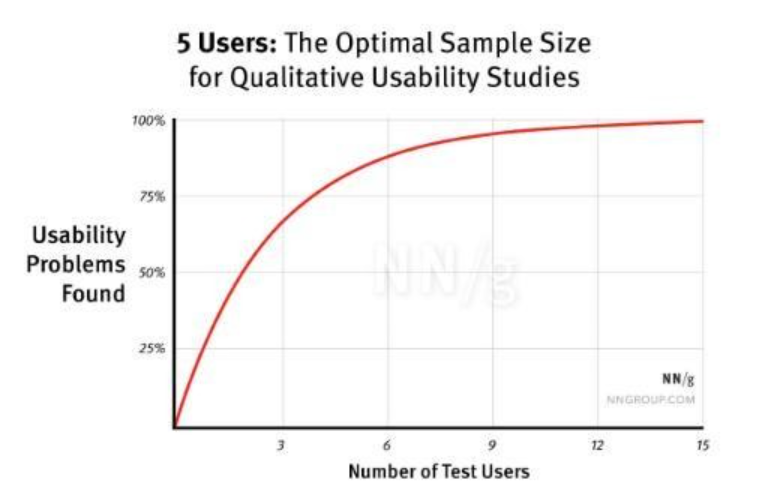
As the chart shows, insight generation rises rapidly during the first few sessions and gradually levels off. The biggest obstacles tend to affect multiple users, which means they are often discovered early.
This principle makes sense when you consider the purpose of qualitative usability testing. Researchers are not trying to estimate how many people in a population behave a certain way. They are trying to identify usability barriers that prevent users from completing tasks successfully.
If four out of five participants struggle to locate a checkout button, misunderstand a navigation menu, or fail to complete a registration process, the issue is already clear. Testing 25 more users may confirm the problem, but it rarely changes the conclusion that the experience needs improvement.
Why International UX Testing Benefits Even More from Early Discovery
The value of early discovery becomes even more apparent when testing products in new markets.
When organizations expand internationally, they often encounter usability challenges that internal teams never anticipated. A design that performs well in one country may create friction in another because of differences in language, expectations, cultural conventions, trust signals, or workflows.
Fortunately, many of these issues are exactly the kind of high-impact problems that surface quickly.
Imagine a company launching an e-commerce platform into a new market. During testing, several participants immediately struggle to understand product categories because translations sound unnatural. Others hesitate to complete purchases because payment methods they expect are missing. A few participants misinterpret important labels because the terminology does not match local usage.
You don’t need 50 users to recognize these patterns.
When multiple participants encounter the same obstacle within a small testing round, researchers can confidently identify it as a priority issue. The findings may not reveal every market-specific challenge, but they often expose the barriers most likely to affect adoption and conversion.
This is particularly valuable for global teams operating under tight timelines. Instead of waiting for a large research program to conclude, they can start making informed improvements immediately.
Early testing also helps organizations prioritize future research efforts. Once major barriers have been addressed, teams can decide whether additional studies are needed to investigate more subtle issues or specific user segments.
The Real Advantage: Iteration Beats Scale
One of the biggest misconceptions about the “five-user rule” is that the number itself is the main takeaway.
It is not.
The most important lesson is that iteration creates more value than scale. Jakob Nielsen’s central recommendation was not simply to test with five users. It was to conduct multiple small rounds of testing, making improvements between each round.
In other words, this approach:
- Test with five representative users.
- Identify major usability barriers.
- Improve the experience.
- Test another five users.
- Repeat the process.
This cycle is often far more effective than conducting a single large study with 15 or 20 participants.
Why? Because usability testing is ultimately a debugging process. The goal is to discover issues, fix them, and validate whether those fixes worked. Every redesign introduces new variables and potentially new problems. Waiting until the end of a large study before making improvements slows down learning.
Consider two hypothetical approaches:
| Approach | Outcome |
| One study with 15 users | Large list of problems discovered before any improvements are made |
| Three studies with 5 users each | Problems are discovered, fixed, validated, and refined across multiple improvement cycles |
The second approach usually delivers greater UX improvements because the product evolves between testing rounds. Researchers are continuously validating solutions rather than simply documenting problems.
For international products, where localization and cultural adaptation often require refinement over time, this iterative process becomes especially powerful.
When Five Users Are Not Enough
Of course, five users are not a universal rule.
The recommendation works best when participants belong to a relatively homogeneous audience. When products serve distinct groups with different goals, behaviors, or contexts, additional participants become necessary.
International products often fall into this category.
For example, a B2B software platform might serve:
- Individual contributors
- Team managers
- Executive decision-makers
A global e-commerce platform might operate across several markets with different buying behaviors and expectations.
In these situations, the question is not whether to test more than five users. The question is how many segments need representation.
Research suggests that testing a few users within each distinct audience is often more valuable than dramatically increasing the sample size of a single group. Nielsen specifically recommends thinking in terms of multiple smaller groups rather than a single large participant pool.
For example:
| Audience Structure | Recommended Approach |
| One primary audience | Approximately 5 users |
| Two distinct audiences | 3-4 users per audience |
| Three or more audiences | Around 3 users per audience |
It’s also important to distinguish between qualitative and quantitative research.
If your goal is to identify usability issues, small samples are often sufficient. If your goal is to produce statistically significant performance metrics or benchmark results, larger samples are required.
The correct sample size depends on the research question you are trying to answer.
Faster Insights, Better Global Experiences
Many organizations delay international usability testing because they believe meaningful insights require large studies. In practice, the most significant usability barriers often appear much earlier.
A small group of representative users can quickly reveal localization errors, navigation challenges, trust issues, and workflow obstacles that would otherwise limit adoption in new markets. Because these high-impact problems affect multiple users, they tend to emerge within the first few sessions.
More importantly, the greatest value doesn’t come from finding every possible issue in a single study. It comes from learning quickly, making improvements, and testing again. The organizations that build the best global experiences are often not the ones running the biggest studies. They’re the ones iterating fastest.
The real question is rarely whether you have enough participants. It’s whether you’re learning and improving quickly enough to keep pace with your users.
Launching or optimizing digital experiences across multiple markets?
Clearly Local’s international usability testing services help you uncover market-specific UX barriers quickly, so you can make informed improvements with confidence. Contact our team to discuss your research goals and find the right approach for your target audiences.
FAQs
1. Is five users really enough for usability testing?
For many qualitative usability studies, five representative participants can uncover the majority of common usability issues. The goal is to identify barriers and friction points, not to produce statistically representative data.
2. Does the five-user rule apply to international UX testing?
Yes, but only when testing a relatively consistent audience segment. In international UX research, small studies can quickly reveal localization, navigation, trust, and workflow issues that affect users in a specific market.
3. When should I recruit more than five participants?
Additional participants are often needed when your product serves multiple audience segments, user roles, or markets with substantially different behaviors and expectations.
4. Is usability testing the same as quantitative research?
No. Qualitative usability testing aims to identify usability problems and understand user behavior, while quantitative research measures performance and produces statistically significant results. The appropriate sample size depends on which type of insight you need.
5. What is the biggest mistake teams make with usability testing?
Many teams delay testing because they believe meaningful insights require large studies. In practice, this often slows learning and postpones improvements that could have been identified much earlier through smaller, iterative testing cycles.