


Key Takeaways
- Subtitles may lower upfront localization costs, but their impact on comprehension, engagement, and content performance may make them more expensive in the long run.
- The effectiveness of subtitles and dubbing depends on the content, audience, and business objective, making localization strategy as important as localization cost.
- Advances in AI dubbing are making high-quality dubbed content more accessible, allowing organizations to optimize for outcomes rather than simply choosing the cheapest option.
Every global brand creating video for international audiences eventually faces a familiar question: subtitles or dubbing. More often than not, the default answer is subtitles. They are faster to produce, cheaper per minute, and easy to ship across markets. In localization—the process of adapting content for different languages and cultures—subtitling has long been treated as the sensible, budget-friendly choice.
That instinct is understandable. Subtitles have become a routine part of how many people consume video. Whether viewers are watching on mobile devices, following content in a second language, or viewing in environments where audio is inconvenient, on-screen text is now a familiar part of the experience. When a format becomes this common, it is easy to assume it works equally well for every type of content.
But there is a difference between the price tag of localization and its true business impact. Upfront cost is only part of the picture. Comprehension, engagement, watch time, and conversion are quite another. Choosing the cheaper option can create hidden costs that ripple through your marketing performance, course effectiveness, and long-term content value.
The question this post explores is simple: when do subtitles become more expensive in the long run? As we will see, viewer research and platform data suggest it happens more often than most budget owners realize—especially in marketing, streaming, and e-learning, where attention and understanding are the whole point.
When Subtitles May Affect Comprehension
To understand why subtitles can underperform, it helps to know how the brain handles them. Reading subtitles is not passive. Viewers must read and watch at the same time, dividing their attention between the text on screen and the content itself.
Eye-tracking research makes the cost concrete. In one study, researchers found that viewers spent about half of subtitle display time reading the text—and up to 60% when subtitles were fast—and that even people who understood the original language read the subtitles anyway. Every second spent on text is a second not spent on the visuals, the action, or the message.
The strain grows as content gets harder. In another study, researchers compared dubbed and subtitled versions of films of differing complexity. For a moderately complex film, both formats worked well. But for a more complex film, subtitled viewers showed more effortful processing and measurably lower cognitive performance. Fast dialogue, technical vocabulary, and dense information are exactly where subtitles begin to break down.
That matters far beyond entertainment. Consider a compliance training video, or a product demo packed with numbers and edge cases. The viewer must read translated text while absorbing on-screen demonstrations, charts, and the speaker’s tone. Something gets dropped—and in high-stakes learning, what gets dropped is often the detail that mattered.
Reduced comprehension has a cascade effect. Learners remember less, employees apply less of what they watched, and audiences leave feeling the content was confusing rather than compelling. For any business that invests in video to teach, persuade, or sell, a format that reduces understanding ultimately works against its intended purpose.
The Hidden Impact on Engagement and Performance
Comprehension is only half the story. The other half is how it feels to watch. Hearing content in your own language is a different experience from reading it: immediate, natural, and immersive. Dubbing—replacing the original audio with a translated voice track—lets audiences follow emotion, tone, and nuance the way the creators intended.
Viewers seem to feel this difference in their behavior. Netflix reported in 2025 that 80–90% of anime viewing on its platform—more than one billion views a year—used dubbed audio rather than subtitles. That is not a niche preference; it is the dominant choice across a massive, global content category. When people can choose how to watch, they often choose to listen.
Subtitles also carry a fatigue cost, especially over long sessions. Reading text for a 40-minute course module or a two-hour film is tiring in a way listening is not. On mobile—where screens are small and attention is already fragmented—that fatigue compounds quickly. It shows up in the data as dropped-off viewers, lower completion rates, and content abandoned halfway through.
Of course, subtitles remain the better choice in many situations, whether audiences are watching without audio or are accustomed to consuming international content through subtitling. The lesson is not that subtitles are ineffective. It is that subtitles and dubbing solve different problems, and choosing between them requires looking beyond production cost alone.
Measuring the Real Business Cost of Subtitles
These small per-viewer losses become easier to see when you multiply them across a global audience, and each content type feels the impact differently.
For streaming platforms, the stakes are retention and content performance. International content is no longer a niche: Netflix says 70% of all viewing in 2025 came from titles produced outside viewers’ home countries, and non-English titles now make up more than a third of viewing hours, up from under 10% a decade ago. As global libraries grow, so does the pressure to serve each market the way it prefers. Netflix leads with dubbing in markets like Germany, France, and Japan, where audiences expect it, while relying on subtitles elsewhere. In dubbing-first markets, subtitled content is often a reason to scroll past.
For e-learning providers, the currency is completion and learning outcomes, and both are sensitive to how content is delivered. In one study comparing Japanese university lectures dubbed into English against the same lectures offered with English transcripts, learners consistently showed higher engagement with the dubbed versions. This shows how dubbing supports both accessibility and engagement, increasing the likelihood that audiences will finish the content and retain what they learn.
For marketers, the cost shows up in the funnel. An ad or product video that viewers must work to follow is an ad that delivers a weaker message. If comprehension drops, so do recall, trust, and ultimately conversion. These losses are invisible in a budget spreadsheet—no line item reads “revenue lost because viewers could not follow the voiceover.” Yet for a product demo, a launch film, or a customer testimonial, the persuasive power of a human voice in the viewer’s own language is hard for text to replace.
Again, none of this means you should dub every video. The mistake is treating subtitling as the default for everything, and measuring success only by production cost. The real metric is ROI: what did this content return in engagement, learning, and revenue, per dollar spent?
Conclusion: Choosing the Right Localization Strategy for ROI
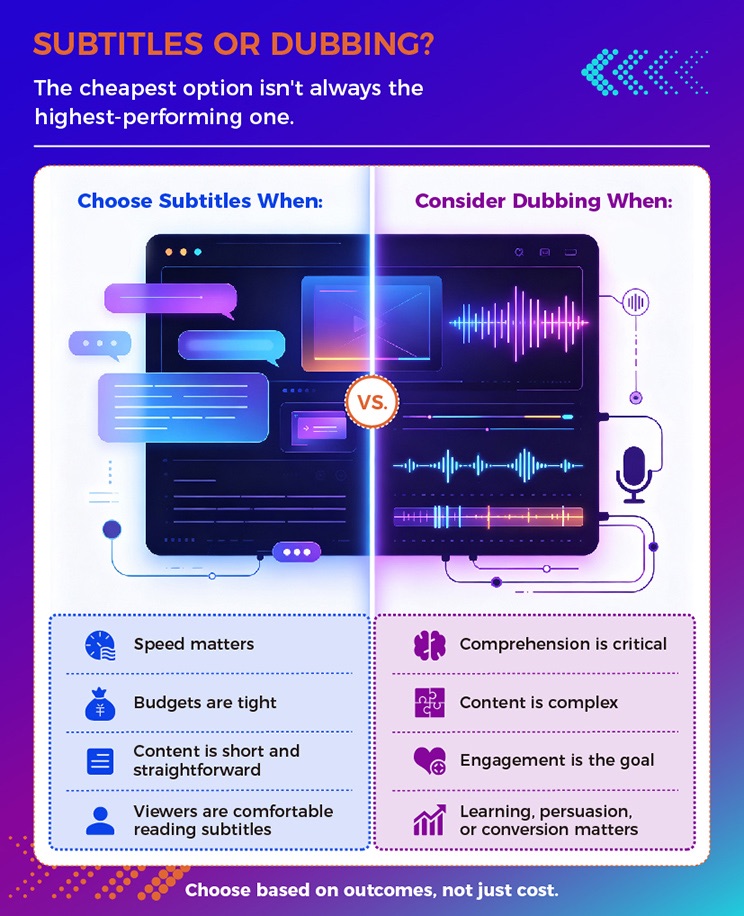
The lowest-cost localization method is rarely the one that delivers the best results. When the content is straightforward, audiences are comfortable reading subtitles, or speed and cost efficiency are priorities, subtitles are often the right tool. When the goal is to immerse, persuade, or teach, dubbing can return far more value for its higher upfront investment.
The good news is that the trade-off is no longer as stark as it once was. AI dubbing, which uses synthetic voices to produce translated audio at a fraction of traditional studio costs, is maturing rapidly. The global market for AI dubbing tools reached an estimated USD 1.35 billion in 2026 and is expected to continue growing at a double-digit rate as demand for multilingual content accelerates.
So the decision is not subtitles versus dubbing in the abstract. It is matching the format to the content, the audience, and the business goal—and pricing the choice in outcomes, not just output. The format that costs the least to produce can end up being the most expensive thing in the room: the message that never landed.
Explore Clearly Local’s Multimedia Localization services to determine the ideal mix of dubbing, subtitling, and localization solutions for your global audiences—and make sure every minute of content earns its place in your budget.
FAQ
Neither dubbing nor subtitles are universally better; the right choice depends on the content, audience, and viewing context. Subtitles are often effective when speed, cost efficiency, and broad language coverage are priorities, while dubbing can be more effective for content that relies on immersion, emotional connection, detailed explanations, or sustained attention, such as training, marketing, and long-form video.
Subtitles may reduce comprehension because they require viewers to read and watch simultaneously, dividing attention between on-screen text, visuals, and spoken information. This additional cognitive effort becomes particularly challenging when content contains complex concepts, fast dialogue, technical language, or important visual elements that compete for the viewer’s attention.
Subtitle fatigue refers to the mental effort that accumulates when viewers must continuously read subtitles for extended periods. Over time, this extra cognitive load can make content feel more demanding, potentially reducing immersion, attention, viewing enjoyment, and completion rates, especially for long-form videos or educational content.
Dubbing is often the better choice when comprehension, engagement, learning outcomes, or persuasion are critical to success. Examples include e-learning courses, product demonstrations, marketing campaigns, customer testimonials, corporate communications, and other content where audiences need to focus on the message rather than divide their attention between reading and watching.
Dubbing can improve engagement by allowing viewers to consume content more naturally in their native language, reducing the effort required to follow the story or message. While conversion outcomes vary by audience and content type, stronger comprehension, immersion, and audience retention can contribute to improved marketing performance, training effectiveness, and overall content impact.
Dubbing typically costs more than subtitling because it involves translation, voice generation or recording, audio synchronization, and quality assurance, whereas subtitles require only text translation and timing. However, advances in AI dubbing are significantly reducing costs and production timelines, making dubbing more accessible for organizations that previously considered it too expensive.
Multimedia localization is the process of adapting video, audio, and interactive content for different languages and cultures. It can include subtitling, dubbing, voice-over, transcription, translation, captioning, graphics localization, and cultural adaptation to ensure content feels natural and effective for audiences in different markets.