


A traveler opens their phone and types: “I want a week somewhere warm in April, not too touristy, good for solo hiking, budget around USD $2,000.” Ten seconds later, they get a shortlist of destinations, a draft itinerary, and hotel options sorted by trail access.
No dropdown menus. No departure airport fields. Just a conversation.
This isn’t a prototype anymore. Nearly four in ten travelers worldwide already use generative AI to plan trips. KAYAK now offers an “AI Mode” that replaces its traditional search fields with open-ended dialogue. Expedia’s assistant Romie reads group chats and emails, understands what the trip is about, and turns casual conversation into bookable plans. The way travelers connect with travel options is changing—and changing fast.
The question for global travel leaders isn’t whether to respond to this shift. It’s whether they understand what the shift truly requires. The answer isn’t better AI. It’s better localization.
As AI becomes the main way people plan trips, localization stops being just a language task and becomes a competitive advantage. The platforms that get this right will lead the conversation. The ones that don’t will disappear from it.
From Filters to Dialogue — How Conversational AI Rewrites Travel Discovery
Traditional travel search is transactional. You type in your origin, destination, dates, and budget, and the system returns matching inventory. You have to force your plans into its form fields. In other words, the traveler has to speak the system’s language.
Conversational AI flips this. The user speaks in their own language—literally and figuratively—and the system has to figure out what they mean. “Something romantic but not cliché” is not something a dropdown menu can handle. “We have a toddler and my parents hate heat” is a mix of needs no filter can capture. Conversational interfaces are designed to handle this kind of fuzzy, contextual, constantly changing human intent.
And the shift is significant. Queries are getting longer and more exploratory. A recent Phocuswright analysis shows that simple keyword searches are declining as travelers increasingly ask full questions like “Where are good wine regions for a family trip?” instead of “Bordeaux hotels.” The starting point of the travel journey is shifting from a destination to a desire.
For travel brands, this changes where and how they need to appear. In keyword search, you optimized for a query like “hotels in Lisbon.” In conversational search, the AI interprets the traveler’s intent and shapes what they even think about. If your inventory, your content, and your brand aren’t baked into that interpretive layer—in the right language and with the right cultural context—you won’t be part of the conversation at all.
The Localization Imperative — Why Global Models Fail Without Local Knowledge
Here is where many AI travel platforms are already running into trouble, and where the consequences are harder to notice than a simple 404 error
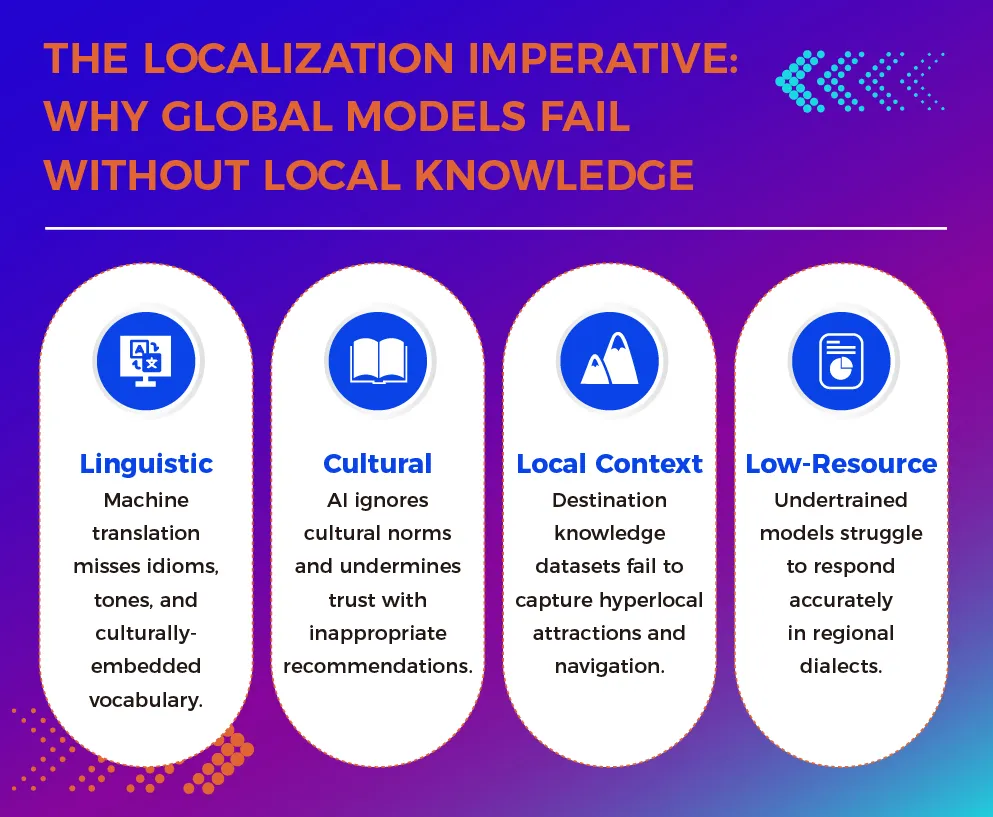
The most obvious problem is language. Machine translation has improved a lot, but it still struggles with idioms, tone, and culturally specific travel terms. When a French speaker asks for a “séjour tranquille,” they’re not just asking for a quiet stay. They’re referring to a whole cultural idea—the pace, the meals, the landscape, the social atmosphere. Translate that as “peaceful accommodation” and you lose the nuance that should guide the recommendation.
Then there’s cultural intelligence—or the lack of it. An AI that recommends nightlife to visitors in conservative markets, or suggests street food without noting whether it’s halal during Ramadan, isn’t just unhelpful. It damages trust in ways that don’t show up in click-through rates until people simply stop using the product. The same goes for subtler cultural differences: many Asian travel markets prefer structured group tours over the freestyle, “go wherever feels right” approach that Western AI often assumes.
Local context adds another layer of difficulty. Destination-level travel knowledge isn’t stored neatly in global datasets. In many places, directions still rely on landmarks. Hyper-local spots, heritage cafes known only to locals, and neighbourhood festivals rarely appear in international tourism portals. Because of this, an AI that excels at recommending Rome’s famous sights may fall short the moment a traveler asks what’s worth doing in a smaller Italian city.
Low-resource language markets make all of this even harder. A traveler planning a trip to rural Thailand and asking questions in a regional Thai dialect is interacting with a model that likely has very little training data for that context. The AI’s answers might be grammatically correct but culturally empty—or, worse, factually wrong in ways the traveler can’t easily spot.
The core issue here is trust. Research consistently shows that travelers trust peer reviews and personal recommendations more than AI-generated advice. Conversational AI platforms are already fighting an uphill trust battle. One culturally insensitive response—a diet suggestion that ignores religious rules, or a phrase that becomes offensive when translated—can erase whatever confidence the user had in the system.
What It Takes to Build a Global Conversational Trip Planner
Solving this is partly a technology problem. But only partly.
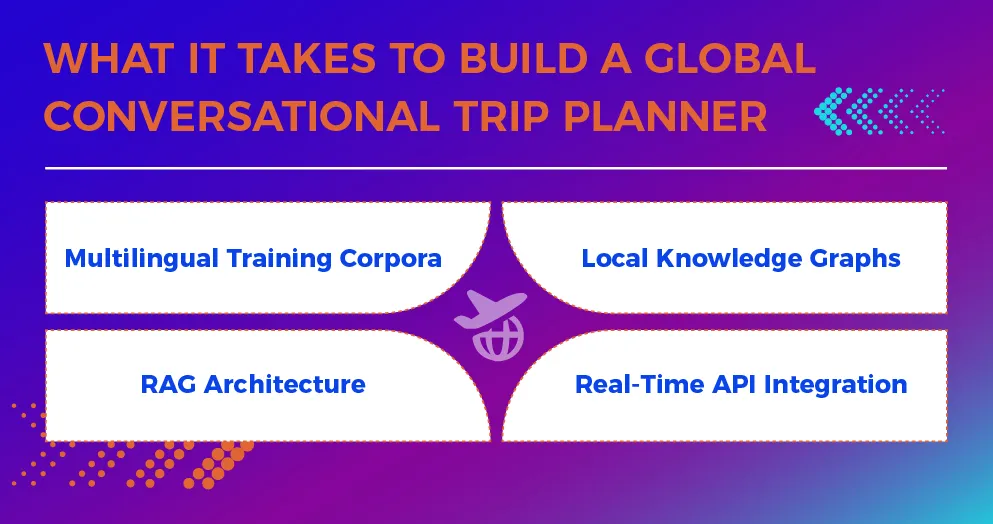
On the data side, platforms need multilingual training data that goes far beyond translated English content. They need travel-specific knowledge graphs built from regional guides, local travel blogs, user reviews written in the traveler’s native language, and destination information curated by people who actually know the place. Resources like Wikivoyage—a collection of more than 142,000 human-curated travel articles—provide a valuable starting point.
The TravelRAG research system showed that building a multi-layer knowledge graph from Chinese travel blogs can meaningfully reduce AI hallucinations and improve recommendation accuracy. The idea is simple: when local data is well-structured, local recommendations become far more reliable.
Retrieval-Augmented Generation (RAG) is the method that makes this possible at scale. Instead of asking a large language model to remember everything—festival schedules, updated visa rules, new restaurant openings—a RAG system pulls in current, verified information from structured sources and feeds it into the model in real time.
This is the difference between an AI that answers with false confidence and one that answers with real accuracy. For travel, where outdated information can cause real problems, that difference matters.
Real-time API integration is just as essential. A conversational trip planner that can’t answer questions like “Is the ferry running tomorrow?” or “What’s the weather like in Kyoto during cherry blossom season this year?” is no better than a well-researched guidebook. Live data for flights, accommodation, weather, currency, and local events is what makes the AI genuinely useful—not just fluent.
Skift’s industry analysis states the hardest part of building conversational travel AI isn’t the model itself, it’s the “plumbing”—connecting the AI to booking engines, pricing systems, customer databases, and inventory in real time.
But here’s the part that often gets overlooked in technical plans: cultural QA and content governance can’t be automated. Native-speaking experts who understand both the travel industry and the cultural context of each market need to be involved in the review process—not as a final touch, but as a core part of how recommendations are created, checked, and updated.
Language and culture are always changing. Platforms need ongoing relationships with localization partners who track those shifts in real time, not one-off translation reviews that happen once and are forgotten.
Conclusion: Localization Is the Competitive Edge in the AI Travel Era
The future of travel planning is conversational, personalized, and global. AI assistants will increasingly be the first point of contact between a traveler and a destination, interpreting what people want, guiding their choices, and influencing what they book. This isn’t a far-off scenario. It’s already happening.
The platforms that succeed won’t be the ones with the biggest models or the fastest processing. They’ll be the ones whose AI truly understands the traveler—their language, their cultural context, their local reality—and responds accordingly.
That means treating localization not as translation, but as a core product capability. It means investing in locally curated content and multilingual training data before markets demand it, not after. And it means partnering with people who understand that “culturally appropriate” isn’t a checklist item but an ongoing, market-specific practice.
The era of conversational travel search is already here. The question is whether your AI can speak to every traveler—not just in their language, but in their world.
Ready to build AI travel experiences that resonate across every market?
Clearly Local provides multilingual datasets, cultural expertise, and global content services purpose-built for the travel industry. Whether you’re training a conversational AI, grounding it with regionally accurate knowledge, or validating its cultural appropriateness across markets, we can help you build trip planners that delight travelers in every corner of the world.
Get in touch with our team to learn how Clearly Local can support your AI localization strategy.