
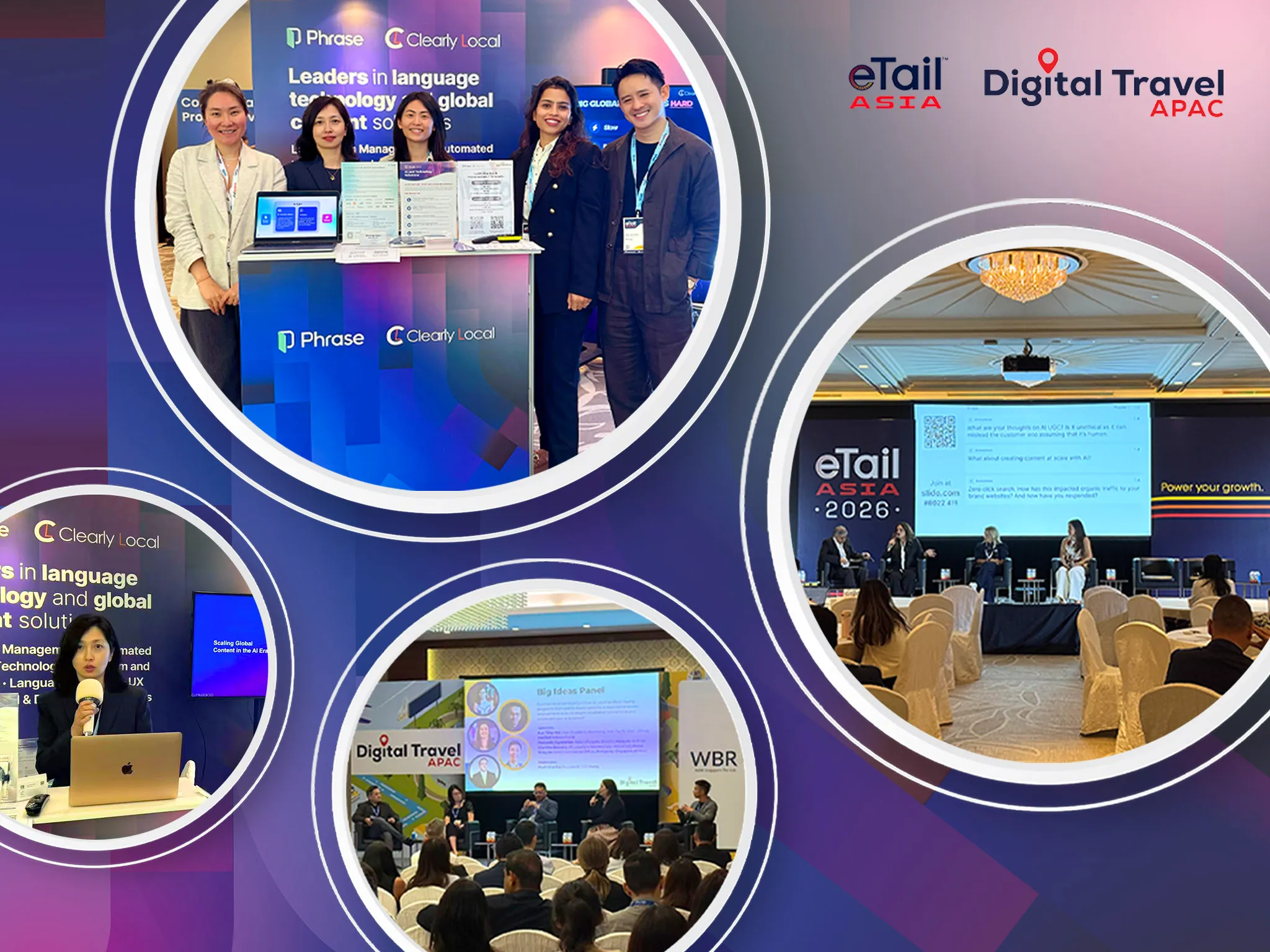
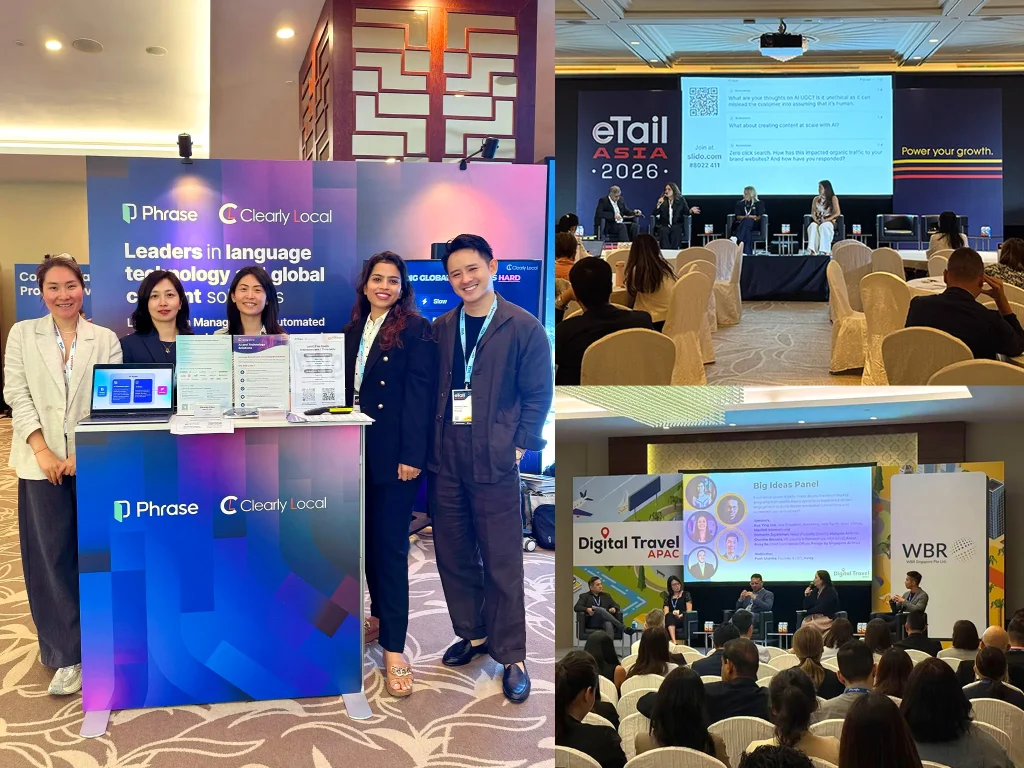
Singapore, March 2026 – Clearly Local attended eTail Asia 2026 and Digital Travel APAC 2026 in Singapore on March 24-25, co-sponsoring both events alongside our partner Phrase. The two conferences brought together senior leaders from e-commerce, retail, travel, and hospitality to discuss how global brands are managing growth across increasingly complex digital markets.
Throughout both events, one theme came up repeatedly: teams are moving fast with AI, but many are still struggling to maintain quality as content scales across languages and markets.
Clearly Local joined these conversations, sharing practical experience from working with global brands across e-commerce and digital travel.
Sharing Practical Experience on Stage
Ally Yuan, Head of Sales at Clearly Local delivered two speeches during the events, both focused on how companies are actually scaling global content today.
The first session, “Scaling Global Content in the AI Era,” addressed a challenge many teams recognize: AI makes it easier to produce content at speed, but it also amplifies inconsistencies when there is no clear system behind it.
Drawing from real customer projects, Ally explained how Clearly Local combines AI with structured workflows, terminology control, and human review. One case showed how a large e-commerce platform used DescripGen AI, Clearly Local‘s custom AI authoring tool, to generate SEO-ready product descriptions across multiple languages in a short time, while still meeting brand and quality standards. Another example focused on building predictable AI translation workflows for high-volume, multilingual content.
The message was direct: AI is effective when it is designed to be controlled. Without that structure, teams end up spending more time fixing problems than moving forward.
The second session, “Fast Expansion: Launching in 6 Markets within 12 Weeks,” shifted the focus from content generation to execution. Ally walked through a complex multimarket launch involving close to 800,000 words of product and UI content, delivered under a tight timeline.
Rather than focusing on translation speed alone, the talk broke down the real sources of delay in global launches: manual handoffs, poor coordination between teams, and late discovery of issues during testing. The case showed how integrating localization directly into product and engineering workflows, batching delivery, and testing early reduced risk and avoided largescale rework.
As Ally explained during the session:
“There’s a lot of focus on AI-and rightly so. AI is extremely powerful, especially when it comes to speed. But AI alone doesn’t solve the problem. If you just add AI on top of an existing process, you often end up scaling the same issues – just faster. What actually makes the difference is how you integrate AI into a structured workflow. AI gives you speed. Humans bring context, nuance, and quality. But workflow-that’s what gives you scalability.”
The takeaway resonated with many attendees: global launches slow down when workflows break, not because of translation itself.
What We Heard from E-Commerce and Travel Leaders
Beyond the sessions, conversations at both events revealed clear patterns in how companies are handling localization today.
Most teams are already using AI tools such as ChatGPT or Gemini. When they have in-house linguists, AI output is reviewed and refined. When they do not, content is often published directly, leading to visible quality issues.
Many organizations also lack a central owner for localization. Translation requests are spread across marketing, sales, and regional teams, each working with different tools or vendors. This results in inconsistent terminology, uneven tone, and limited ability to scale when volumes increase.
Capacity remains a common pressure point. Even companies with internal translation teams struggle when content updates become frequent or when new markets are added quickly. Leaders from both e-commerce and travel brands spoke openly about the difficulty of finding reliable partners who can step in when internal resources reach their limits.
There is also growing uncertainty around how to use AI responsibly when expanding into new markets.
Voices from the Event Floor
“My sales and marketing teams are translating materials, but the quality is not good enough. I want to know how to improve it.”
“I want to know how to find reliable vendors when my in-house translators can’t handle additional translation work.”
“For some marketing teams, how to leverage AI to expand into new markets is a key topic they need to understand.”
What This Means for Global Growth
The discussions at eTail Asia and Digital Travel APAC highlighted a gap between ambition and execution. Companies want to expand faster and reach more markets, but many are still relying on fragmented processes that do not scale.
AI is now part of almost every content workflow. The difference between teams that struggle and teams that succeed lies in how AI is used. Structured workflows, shared terminology, early quality checks, and clear ownership make the difference between speed with control and speed with risk.
Our key takeaway? E-commerce and digital travel leaders are starting to view localization as a core part of product experience, brand trust, and revenue growth in international markets.
Explore How Clearly Local Supports Global Teams
Clearly Local works with e-commerce and digital travel brands to design localization systems that combine AI, human expertise, and clear workflows. The result is high-quality, market-ready content across languages and regions.
To learn how Clearly Local can support smoother international expansion for your business, speak with our team.