


A Lesson from a Support Call
Early in my career, during a college internship at a data recovery software company, I was handling technical support calls and writing technical documentation. One call still stands out vividly in my memory.
A user contacted us asking how to register our software. My initial reaction was frustration—hadn’t she read the guide? Impatient and confident in my efficiency, I simply directed her to the documentation:
“Find the electronic registration code in your email and copy-paste it into the activation field.”
She paused. Then asked,
“How do I copy? How do I paste?”
I was totally astonished. But as we continued talking, I learned she was a university professor in Europe who rarely used computers. She had accidentally deleted critical research data and was desperately trying to recover it. She wasn’t careless in reading our manuals, she simply lacked basic computer literacy.
Later I discussed this with our product manager, I was told that accidental data loss from user maloperations accounted for most of our support cases, and a lot of these cases are caused exactly by lack of computer literacy. These conversations changed my perspective entirely. Instead of blaming users for lack of computer common sense, our documentation should be ready to support users like her—people who needed simple, intuitive guidance, not technical jargon.
This experience taught me a fundamental truth: Understanding your customer isn’t optional—it’s the foundation of effective technical documentation.
As a professional technical documentation service provider, Clearly Local has seen firsthand how tailored content transforms user experience. In this article, I’ll share with you the multidimensional audience framework we use to help teams craft technical documentation that truly meets user needs.
Dimension 1: Job Role and Professional Identity
Who is reading your documentation?
A software engineer integrating an API has fundamentally different needs than a business executive reviewing a product dashboard. Consider these distinctions:
| Role Type | Documentation Needs |
|---|---|
| Developers | Code samples, API references, technical specifications |
| End Users | Step-by-step guides, screenshots, troubleshooting tips |
| Administrators | Configuration options, security settings, maintenance procedures |
| Decision Makers | High-level overviews, ROI analysis, compliance information |
Best Practice: Create persona-based documentation paths. Label content clearly so users can quickly identify sections relevant to their role.
Dimension 2: Experience Level
How familiar is your audience with the subject matter?
Experience level directly impacts the depth and pacing of your content:
- Beginners need foundational concepts explained, glossaries, and gradual skill building
- Intermediate users benefit from best practices, optimization tips, and common use cases
- Experts prefer concise references, advanced configurations, and edge case handling
Warning: Never assume expertise. Even experienced professionals may be new to your specific product. Include optional “deep dive” sections that experts can access without overwhelming beginners.
Dimension 3: Educational Background
What is your audience’s technical literacy?
Educational background influences how users process information:
- Users with technical degrees typically understand industry terminology and abstract concepts
- Users with non-technical backgrounds may need analogies, visual aids, and plain language explanations
- Mixed audiences require layered content—start simple, then offer technical details for those who want them
Implementation Tip: Use a “progressive disclosure” approach. Present core information first, then provide expandable sections for technical details.
Dimension 4: Economic Considerations
What is the cost-benefit expectation?
Economic factors affect how users engage with documentation:
- Enterprise clients often prioritize compliance, security, and integration capabilities. They expect comprehensive documentation that supports procurement decisions.
- Small businesses focus on quick deployment and cost efficiency. They prefer streamlined guides that minimize training time.
- Individual consumers value ease of use and immediate results. They need intuitive, self-explanatory content.
Strategic Insight: Align documentation depth with pricing tiers. Premium customers often expect premium support materials.
Dimension 5: Hands-On Capability
Can your users execute the tasks independently?
Practical ability varies significantly across audiences:
| Capability Level | Documentation Approach |
|---|---|
| High | Minimal hand-holding guidance, focus on specifications and options |
| Medium | Balanced guidance with clear procedures and examples |
| Low | Detailed walkthroughs, video tutorials, and interactive guides |
Key Consideration: Assess the complexity of tasks your documentation covers. Critical operations may require multiple formats (written, video, interactive) to accommodate different learning styles.
Dimension 6: Primary Concerns and Priorities
What keeps your users up at night?
Understanding user priorities helps you structure content effectively:
- Security-conscious users need detailed information about encryption, access controls, and compliance certifications
- Performance-focused users want benchmarks, optimization strategies, and scalability information
- Budget-aware users seek cost estimates, resource requirements, and work efficiency metrics
- Time-pressed users value quick-start guides, cheat sheets, and searchable FAQs
Action Item: Conduct user surveys or support ticket analysis to identify the most common concerns. Make this information prominently accessible in your documentation.
Putting It All Together: A Practical Framework
Step 1: Audience Mapping
Create a matrix that plots your user segments across all six dimensions. This visual representation helps identify documentation gaps and overlaps.
Step 2: Content Tiering
Develop three tiers of content for each major topic:
- Quick Start (5 minutes)
- Standard Guide (15-30 minutes)
- Comprehensive Reference (deep dive)
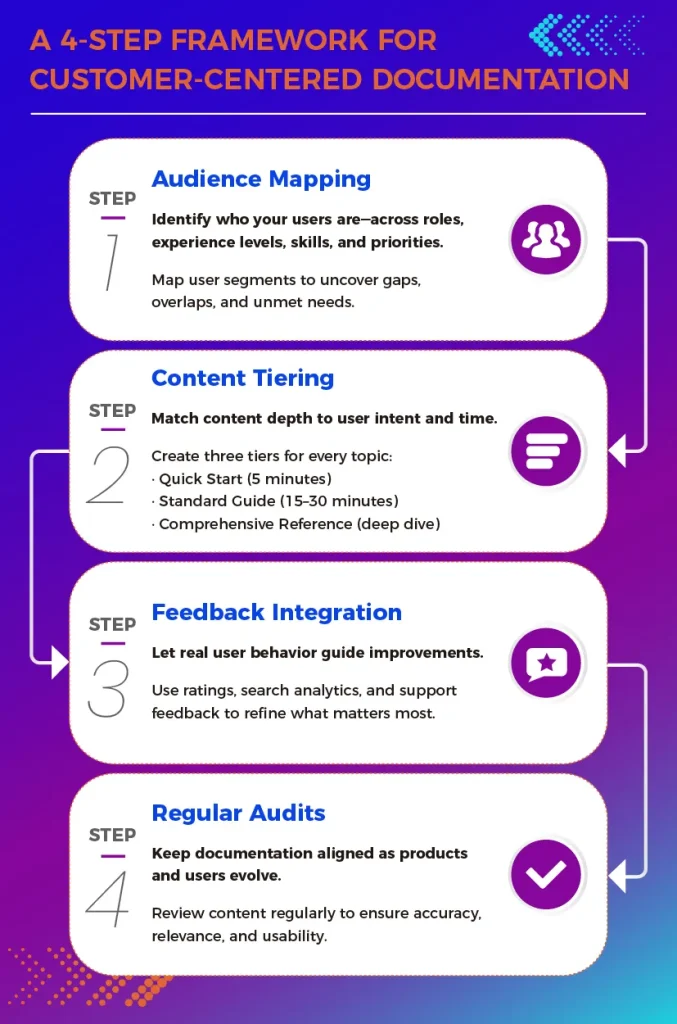
Step 3: Feedback Integration
Establish mechanisms for continuous improvement:
- User ratings on documentation pages
- Search analytics to identify missing content
- Support team feedback on common questions
Step 4: Regular Audits
Schedule quarterly reviews to ensure documentation stays aligned with evolving user needs and product changes.
Why Professional Documentation Services Matter
Creating multi-dimensional documentation is resource intensive. It requires:
- Audience research expertise to accurately profile user segments
- Writing specialization to adapt tone and complexity appropriately
- Information architecture skills to organize content intuitively
- Continuous maintenance to keep materials current and relevant
This is where professional technical documentation services deliver exceptional value. Our team specializes in audience analysis, content strategy, and documentation design that scales with your business.
What are Clearly Local Offerings
Clearly Local offers professional Technical Documentation Outsource (TDO) solutions covering:
- Comprehensive audience profiling and persona development
- Multi-format documentation (written, video, interactive)
- Localization and accessibility compliance
- Analytics-driven content optimization
Conclusion
That phone call with the professor taught me something no textbook could: behind every support ticket is a human being with unique circumstances, challenges, and needs. The professor didn’t need a technical manual, she needed patience, empathy, and instructions that matched her actual skill level.
Understanding your customer isn’t a one-time exercise, it’s an ongoing commitment to empathy and precision. By analyzing users across job role, experience level, education, economic factors, hands-on capability, and primary concerns, you create documentation that doesn’t just inform but empowers.
The companies that thrive in today’s competitive landscape are those that recognize documentation as a strategic asset, not an afterthought. Invest in understanding your audience, and your documentation will become a powerful driver of user satisfaction, reduced support costs, and accelerated product adoption.
Ready to transform your technical documentation? Our team is here to help you build content that truly understands—and serves—your customers.

Allen Xue, Technical Documentation Lead
Allen Xue is a seasoned technical documentation expert with extensive experience across the telecommunications and software industries. Having served as technical writer and led content teams at global enterprises including Alibaba Cloud, Nokia, Siemens and Cisco, Allen brings deep expertise in documentation development and ecosystem governance.