

Key Takeaways
- AI is now central to technical communication, but most current solutions remain fragmented, experimental, and far from mature.
- There is no one-size-fits-all approach to AI-driven technical content, and organizations must rely on ongoing experimentation and iteration to find what works for them.
- The real opportunity lies in combining AI capabilities with human expertise to build tailored, practical solutions that deliver measurable business value.
From Hype to Reality at tcworld 2026
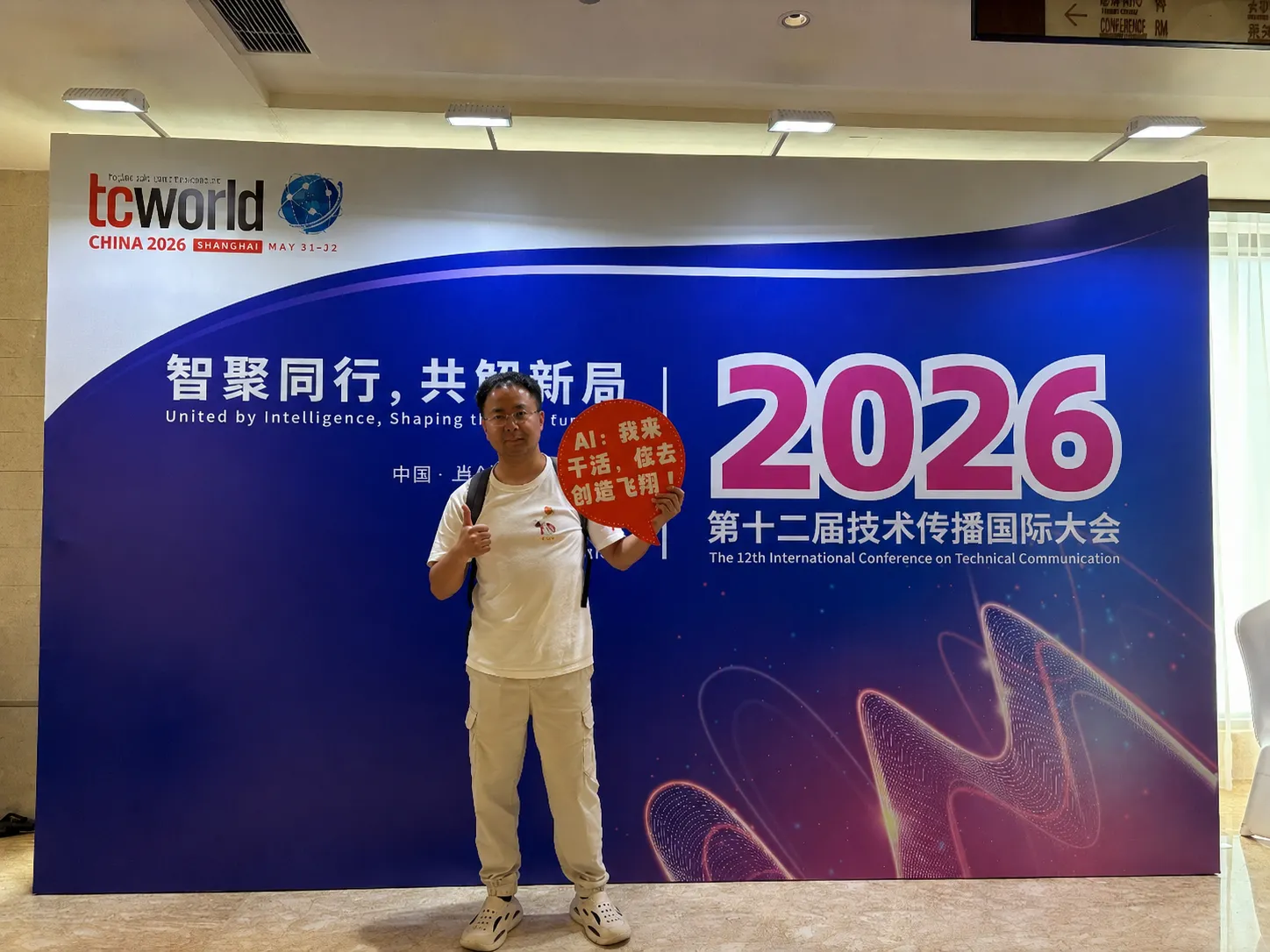
tcworld is one of the most significant gatherings in technical communication, drawing practitioners, strategists, and technology vendors from across the globe. The 2026 edition, held in Shanghai, carried unusual weight. For the first time, it felt less like a forum for exploring ideas and more like a pressure cooker—an industry collectively wrestling with a question it can no longer defer: not whether AI matters, but how to actually make it work.
Clearly Local joined the event across two days, moving between sessions, speaking with attendees, and observing what was said—and crucially, what wasn’t.
What we observed was an industry somewhere between curiosity and capability. While technical leaders are eager to adopt, they’re still searching for the clarity, maturity, and strategic frameworks that will make adoption meaningful.
This article distills what we saw on the ground, including the dominant trends, the frustrations beneath the surface, and the practical implications for technical communication leaders at global enterprises.
AI Everywhere: The Dominant Theme Shaping Technical Communication
If you attended tcworld 2026 expecting a balanced program, you likely left surprised. AI dominated the entire program. AI-driven workflows, intelligent content generation, automated review pipelines, agentic documentation systems, chatbot interfaces for technical writers—session after session returned to the same territory from slightly different angles.
What was genuinely new, compared to prior years, was the level of applied specificity. Speakers were no longer just explaining what AI is or why it might matter. They were demonstrating it with CLI-based (command line interface) generative tools, end-to-end multi-agent documentation pipelines, and AI-powered review tools that flag inconsistencies and style deviations in real time. The field has clearly progressed from conceptual enthusiasm to applied experimentation.
Particularly striking was the expansion into industry-specific domains. Sessions explored AI applications in manufacturing documentation, intelligent vehicle systems, cloud service operations, and industrial engineering contexts. One presentation outlined a multi-agent technical documentation system designed to manage an entire product documentation lifecycle autonomously—from initial content generation to review, versioning, and publication.
Another introduced an AI-driven knowledge flywheel model aimed at improving cloud service efficiency through continuously evolving documentation.
The sheer breadth of use cases was impressive. But an impressive breadth is not the same as mature depth. As Clearly Local’s technical documentation lead Allen Xue observed, “I think many of these talks still focus on using AI to generate simple, highly structured content in different ways, with only slight variations in focus. A standard or mature solution still seems far away.”
Despite the volume and variety of presentations, most of what was showcased remains fragmented and experimental. There was no dominant playbook, no widely validated methodology, and no clear consensus on what “good” looks like at scale. The field is in an exciting phase, but it would be a mistake to confuse activity with advancement.
Beneath the Surface: Industry Frustrations and Unanswered Questions
The most revealing moments at tcworld 2026 didn’t happen during the keynotes. They happened in the Q&A sessions, in the hallway conversations, and in the expressions of audience members after the applause faded.
AI fatigue
AI fatigue was real and palpable. “There are too many AI-related topics—they made me very tired,” one attendee told us directly. This was a signal that the industry’s most experienced practitioners are hungry for substance beyond enthusiasm.
After a certain number of “we used AI to do X” presentations, one question remained unanswered: “But does it actually work, at scale, for organizations like mine?”
Our take is that there is no standard AI technical content solution for all industries and organizations. Instead, meaningful progress will likely come through continued experimentation, iteration, and refinement over time. For organizations navigating this landscape, the real opportunity lies in building tailored approaches that align with their specific workflows, content needs, and business goals—an area where experienced content partners like Clearly Local can play a critical role.
Job security
Job security was the subtext of many conversations. Technical writers were openly asking whether AI-powered tools represent a genuine augmentation of their capabilities, or just a slow displacement of their roles.
The concern isn’t unfounded. If a CLI-based chatbot can produce structured technical content, what is the long-term value of a human technical writer? These are questions the industry needs honest, evidence-based answers to, not reassurances.
Cost and ROI
Cost and ROI were equally contested. Several attendees raised pointed questions about the economics of AI adoption:
- “How does the cost of running AI tokens at scale compare to maintaining a team of skilled writers?”
- “What happens when hallucinations introduce errors that require significant human correction?”
- “What is the true cost of building, validating, and maintaining AI-powered documentation workflows?”
One session illustrating this gap particularly stands out: after an hour-long technical presentation on a CLI-based generative AI documentation solution, an audience member asked the speaker to compare the CLI approach to traditional UI-based tools. The speaker explained that the system had been developed by the engineering team and that she wasn’t closely involved in its details, leaving the comparison with more established approaches unclear.
The consistent pattern was a gap between technical demonstration and business applicability. Leaders weren’t looking for more proof-of-concepts. They were looking for clarity on how to make strategic decisions, build business cases, measure outcomes, and manage adoption risk. That clarity, by and large, wasn’t on offer.
The Real Opportunity: Human Expertise as the Missing Piece
Paradoxically, the most compelling insight from tcworld 2026 wasn’t about what AI can do. It was about what it still can’t.
Hallucination remains an unsolved problem. Content quality is inconsistent across use cases. Workflows are still maturing. And almost every AI documentation solution demoed at the conference still required meaningful human involvement at multiple stages, including authoring oversight, quality validation, style governance, and error correction.
The word “automated” appeared frequently, but the fine print almost always revealed a human in the loop.
What we observed in audience behavior reinforced this point. The practitioners who showed the most interest were urgently trying to understand how to implement what they were seeing. One attendee told us she didn’t fully grasp the benefits of a particular AI approach, and couldn’t see how it applied to her work, but she was determined to track down the speaker afterward and dig further.
That drive is admirable. But it also signals that most teams are navigating adoption without a clear map.
Our read is that for many teams, anxiety is the primary driver of AI adoption right now—fear of falling behind, fear of obsolescence—rather than clear business logic. That’s not necessarily bad; pressure can accelerate learning. But it does mean organizations risk making expensive investments in immature tools without the strategic foundations to extract real value.
The practical implication for enterprise leaders is this: the winning approach isn’t to replace human documentation expertise with AI. It’s to build hybrid models that integrate both. AI excels at scale, speed, and consistency within well-defined parameters. Human experts provide judgment, domain knowledge, quality assurance, and the contextual understanding that AI still genuinely lacks.
The organizations that will thrive are those that invest in both, and design workflows where each plays to its strengths.
Practically, this means prioritizing workflow integration over tool acquisition, building quality control frameworks before scaling AI output, and defining measurable outcomes before committing to broad adoption. Experimentation has its place, but it should be structured and purposeful.
Turning tcworld Insights into Action
tcworld 2026 made one thing unmistakably clear: AI is reshaping technical communication, and that process is already underway. The more nuanced truth is that the field is still in an early, often messy, stage of that reshaping. The solutions are multiplying faster than the evidence base. The enthusiasm is real, but so is the uncertainty.
For technical communication leaders, we believe the corehe challenge is engaging AI strategically, which means asking harder questions than the conference stage usually allows: What specific outcomes are we trying to achieve? How will we measure them? What happens when the AI gets it wrong? Who owns quality?
The organizations best positioned to succeed aren’t necessarily the earliest adopters. They’re the ones that combine genuine innovation with proven documentation expertise, and treat AI not as a shortcut but as a capability to be built, measured, and refined over time.
At Clearly Local, that’s exactly the balance we help enterprise teams navigate. We combine the rigor of professional technical documentation practice with a pragmatic, evidence-driven approach to AI integration. If you’re thinking through your documentation strategy in light of what’s happening in the field right now, we’d welcome the conversation.