


What if one of your highest-return investments isn’t in product or marketing, but in documentation?
Last week, Clearly Local hosted a webinar where this question set the tone for a deeper discussion on how technical documentation contributes to measurable business outcomes. While documentation is often treated as a necessary output, the session reframed it as a strategic function that directly influences efficiency, scalability, and competitive advantage.
The sessions were led by Jill Huang, Customer Success Director, and Allen Xue, Technical Documentation Lead—two seasoned experts in localization, technical writing, and enterprise documentation systems. Drawing on their work with global organizations including Fortune Global 500 companies, they shared both strategic perspectives and hands-on insights from real-world projects.
What emerged from the discussion was not a single takeaway, but a clear pattern. Documentation sits at the intersection of operations, user experience, and growth, influencing how effectively organizations scale and perform across markets.
Documentation and ROI: Connecting the Dots
The value of documentation is often underestimated because its impact is distributed across the organization. It does not sit within a single function, which makes it harder to measure directly. However, when documentation improves, the effects are visible across multiple areas.
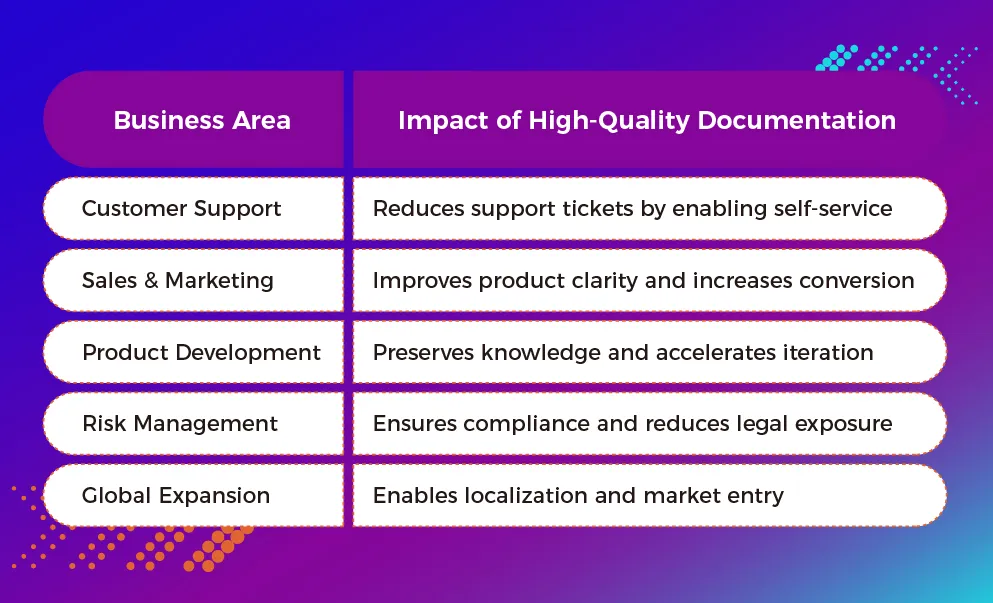
These benefits do not operate in isolation. They reinforce each other. Clear documentation reduces support demand, which frees up resources. Better onboarding improves user adoption, which supports revenue growth. Efficient localization accelerates market expansion.
The Hidden Cost of Poor Documentation
The webinar highlighted that if strong documentation creates leverage, poor documentation creates friction. This friction is rarely visible as a single issue. Instead, it appears across workflows and teams.
Common symptoms include:
- Repetitive support queries that could be resolved through clear instructions
- Inconsistent messaging across products or markets
- Delays in localization due to unstructured content
- Increased effort in maintaining and updating documentation
Over time, these issues accumulate and begin to affect performance. Support teams become overloaded. Product teams spend time clarifying information that should already be documented. Localization becomes slower and more expensive.
As highlighted in Everything Gets Harder When Your Technical Content Goes Global, these challenges scale with the business. Without structure, complexity grows faster than the organization can manage.
Why Documentation Breaks at Scale
In early stages, documentation is often informal. Engineers or product managers create content as needed, typically using unstructured formats such as Word or PDF. This approach can work when products are simple and teams are small.
As organizations grow, several pressure points begin to emerge:
- Content volume increases significantly
- Multiple product lines introduce variation in structure
- Teams expand across regions with different practices
- Documentation must be translated into multiple languages
- Updates become more frequent
Without a structured approach, these factors introduce inconsistency and inefficiency. It becomes harder to maintain content, and version control becomes difficult. In turn, localization costs rise due to duplicated effort.
At this stage, documentation shifts from being a manageable task to becoming a constraint on growth.
Structured Content as a Growth Multiplier
Structured documentation provides a way to manage complexity while supporting scale.
Instead of treating documents as standalone files, structured content organizes information into reusable components. These components can be updated once and reused across multiple outputs, formats, and markets.
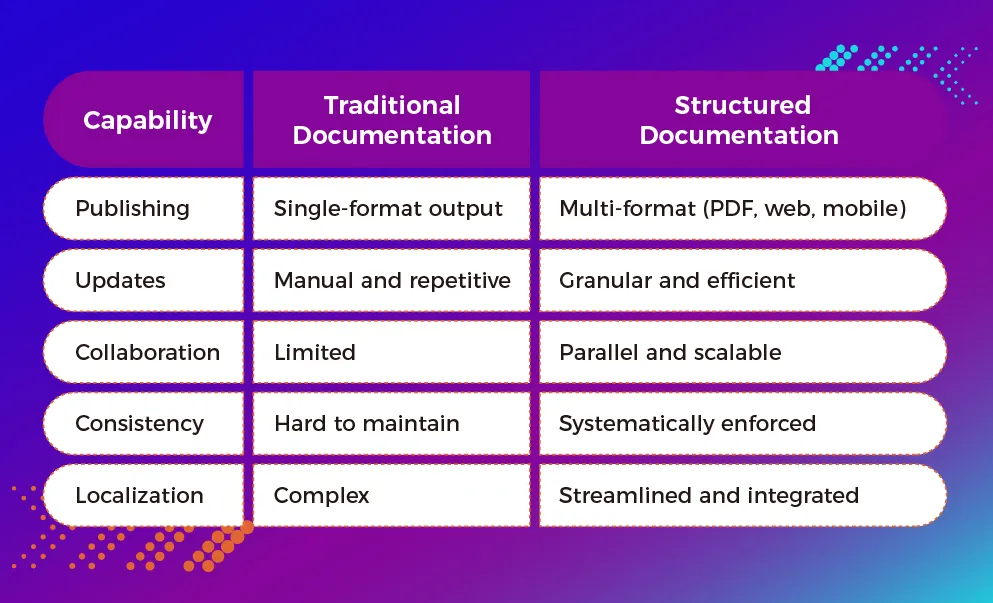
Allen Xue pointed out how frameworks such as DITA (Darwin Information Typing Architecture) enable this model, but the real value lies in the operational shift. Content becomes a system rather than a collection of files.
This aligns with what Clearly Local describes as Multi-Dimensional Technical Documentation, where content supports multiple audiences, formats, and regions simultaneously.
Case Studies: Where Documentation Delivers Business Impact
The webinar made one point clear. Documentation improvements are not just about content quality. They translate into measurable business outcomes. Across industries, the biggest gains came from reducing friction and improving how work gets done.
Cibes (Home Elevators)
Challenge: Engineer-written manuals were difficult for installers to follow in real-world conditions, leading to inefficiencies and reliance on support.
What changed: Documentation was redesigned around actual installation workflows, with clearer step-by-step structure, improved diagrams, and a concise installation video developed from over 1,000 footage clips.
Business impact: Faster installations, fewer errors, and reduced support dependency, improving consistency in field execution.
KSTAR (Solar Energy)
Challenge: Unstructured content and inconsistent language made documentation difficult to navigate and created confusion across markets.
What changed: Content was reorganized with a user-focused structure, language quality was improved through native editing, and layout was optimized for readability.
Business impact: Clearer communication across teams and regions, reduced ambiguity, and more efficient collaboration in global operations.
Corning (Manufacturing)
Challenge: Need for bilingual SOPs that could support both regulatory compliance and operational training in a new factory environment.
What changed: A dedicated documentation team worked on-site to build structured templates, standardized terminology, and consistent workflows aligned with engineering processes.
Business impact: Scalable, compliant documentation that supports training, reduces risk, and ensures consistency across languages and operations.
Lenovo (Electronics)
Challenge: Fragmented documentation across multiple product lines resulted in inconsistent structures and inefficiencies in global content management.
What changed: A unified documentation approach was introduced, including structured content, CMS integration, and end-to-end support from creation to localization.
Business impact: Improved consistency across product lines, reduced duplication, and a more efficient documentation lifecycle at scale.
The Common Thread
Across all cases, the value did not come from adding more content, but from making documentation more usable, structured, and aligned with real workflows. When documentation reduces friction, the impact becomes measurable. Tasks are completed faster, errors decrease, and operations scale more efficiently.
This is where documentation moves from a cost center to a source of measurable return.
Clearly Local’s Solutions
To address the challenges discussed, Clearly Local introduced a suite of solutions designed to support organizations at different stages of maturity.
At the core is the Technical Documentation Outsourcing (TDO) model, which provides a flexible alternative to building large in-house teams.
Technical Documentation Outsourcing (TDO)
Provides scalable execution across writing, design, and localization. This allows organizations to maintain quality while adapting to changing demands.
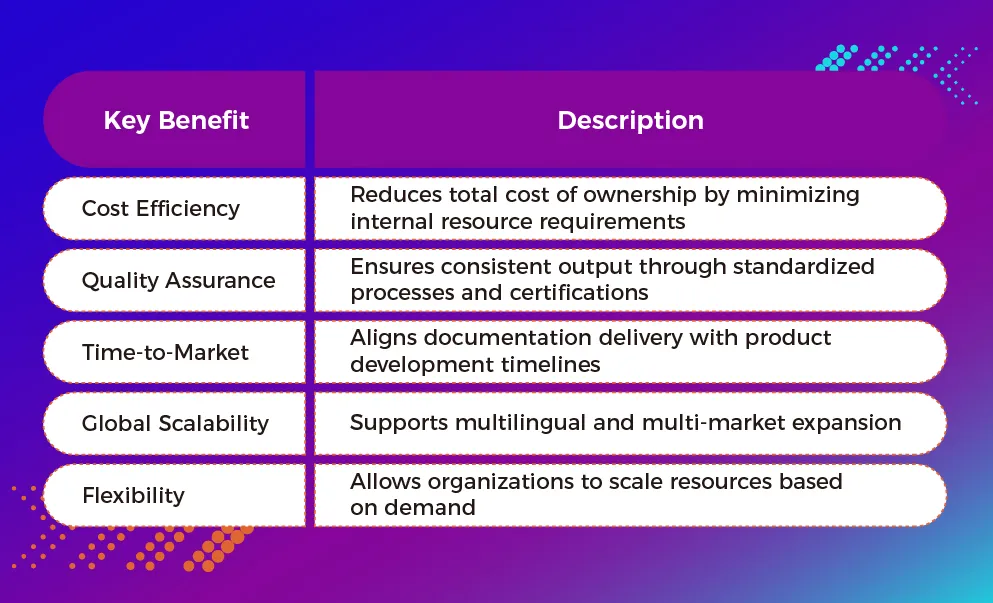
This model is particularly valuable for companies navigating rapid growth, where documentation needs fluctuate and internal resources may be limited.
Technical Documentation Consulting (TDC)
Focuses on strategy and system design. It helps organizations assess their current state and define frameworks that support long-term scalability.
Structured Technical Documentation Migration
Supports the transition from unstructured formats to structured systems such as DITA. This enables content reuse, improves consistency, and reduces localization effort.
Together, these solutions address both immediate operational needs and long-term transformation.
Process Over Individuals: The Foundation of Quality
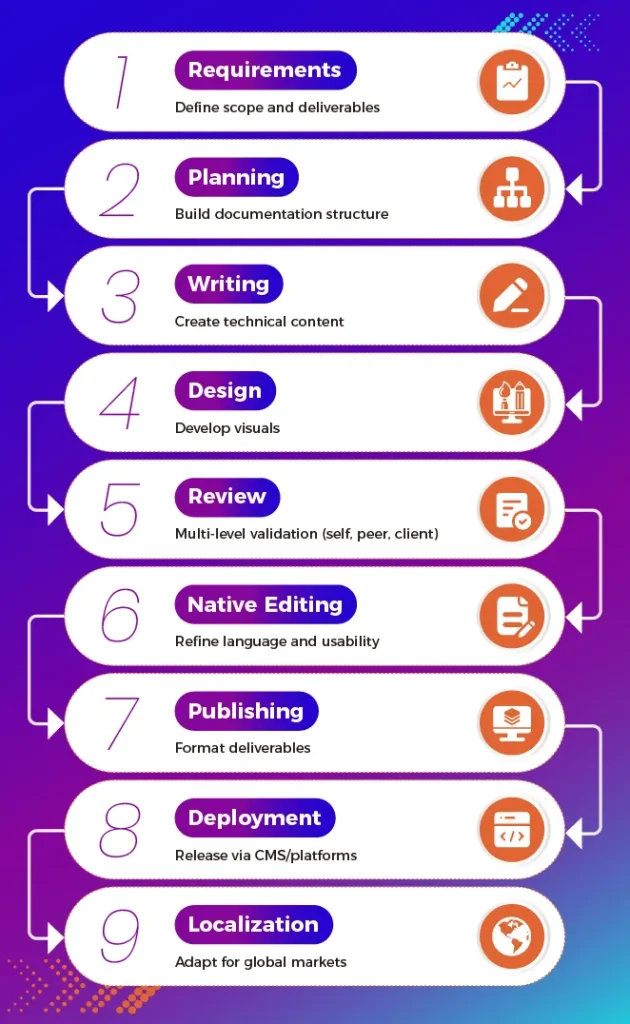
A recurring message throughout the session was that quality documentation is not dependent on individual expertise; it is built on robust processes.
Clearly Local’s workflow reflects this philosophy, following a structured lifecycle that mirrors product development. This ensures consistency and scalability across projects.
From Accuracy to Business Impact
A key insight from the webinar is that technical accuracy alone does not create value. Documentation must enable users to complete tasks efficiently. It must reduce friction across workflows and support consistency across markets.
Organizations that prioritize usability alongside accuracy see measurable improvements in performance.
This shift changes how documentation is evaluated. Success is no longer defined by correctness alone, but by how effectively content supports real-world use.
What Attendees Asked
The Q&A session reflected common questions from organizations looking to improve their documentation strategy.
When should we invest in structured documentation?
Before complexity becomes difficult to manage. Early investment reduces long-term cost and effort.
How do we justify documentation investment internally?
By connecting documentation improvements to measurable outcomes such as reduced support costs, faster onboarding, and improved user satisfaction.
What is the best operating model?
A hybrid approach is often most effective. Internal teams retain ownership and domain knowledge, while external partners provide scalability and specialized expertise.
What is the first step toward improvement?
Start by understanding current gaps. Establish structure, define ownership, and standardize processes.
Assess Your Documentation Readiness
Is your documentation ready to scale with your business?
Clearly Local’s technical writing solutions are now available on the dedicated landing page, where you can explore service offerings, methodologies, and case studies.
Final Thoughts
The webinar made one point clear: the impact of documentation on business performance is often underestimated, but it is measurable.
From reducing operational friction to enabling faster market expansion, documentation plays a critical role in how organizations scale. Companies that treat it as a strategic function, rather than a secondary task, gain a meaningful advantage.
As discussed throughout the session, the question is no longer whether documentation delivers ROI, but whether it is structured to do so effectively.
Ready to transform your technical documentation? Contact us today to explore how our TDO, TDC, or structured content migration solutions can accelerate your global growth.