


Key Takeaways
- Localization teams often mistake internal quality signals (like linguistic accuracy and SLA compliance) for success, even though real success is determined by business outcomes like conversion, engagement, and retention.
- Because performance data sits in other departments, localization teams lack visibility into how their work actually performs, forcing them to rely on disconnected internal metrics and operate on guesswork.
- To become strategic contributors, localization teams must integrate with analytics systems and redefine quality around measurable audience impact rather than just translation correctness.
Here is a question worth sitting with: if your localization team produces translations that pass every internal review, hit every deadline, and satisfy every linguistic checklist—but the localized landing page still converts at half the rate of its English counterpart—was the work actually good?
Most localization leaders would hesitate before answering. And that hesitation is revealing.
Across the industry, localization teams are held accountable for quality in ways that are rarely connected to what quality is supposed to produce. Reviewers score translations. Managers approve workflows. Vendors hit SLAs (service level agreements). And somewhere else entirely—in a marketing dashboard, a product analytics tool, or a regional sales report—the actual verdict on whether that work succeeded is quietly being recorded by people who have little visibility into localization and even less incentive to share the data back.
This is the operational gap. And until it closes, localization will continue to operate on a foundation of informed guesswork rather than business intelligence.
The Redefinition of “Quality” in Modern Localization
For a long time, quality in localization meant linguistic precision. Was the translation accurate? Were the terminology choices consistent? Did the output conform to the style guide? These are still important questions, but they have become table stakes rather than differentiators.
The bar has moved.
In a world where AI can produce grammatically correct, technically accurate translations at scale and at speed, accuracy alone no longer justifies the investment in high-quality human localization. What justifies that investment is impact—measurable, audience-level impact.
Think about what “fit for purpose” actually means in practice. A product page localized for the German market should not just be correctly translated; it should drive product page conversions at a rate comparable to what the source market achieves. A customer onboarding email sequence localized for Japan should not just avoid cultural missteps; it should influence whether users return after their first week. A support article localized for Latin American Spanish should not just be comprehensible; it should deflect customer support tickets.
The connection between localization and business performance runs even further upstream than most teams realize. As explored in our recent webinar with Phrase and Dreame, localized content doesn’t just convert audiences who are already on your site—it determines whether those audiences find you at all. Search visibility in a local market is itself a quality metric, one that depends on terminology choices, natural language patterns, and cultural relevance. A team that optimizes for linguistic accuracy but ignores how local users actually search is solving for the wrong variable.
Organizations that understand this have begun reorienting their quality definitions around new localization metrics that more accurately reflect localization ROI: conversion, engagement, and retention. Traditional metrics like linguistic accuracy still matter, of course, but they’re a basic quality requirement now. In other words, content that is accurate but doesn’t move people is not high-quality content.
The Operational Gap: Why Localization Teams Are Flying Blind
If the definition of quality has expanded to include business outcomes, then localization teams have a serious structural problem: they almost never have access to the data that measures those outcomes.
The metrics that matter—click-through rates, time on page, conversion rates, retention curves, support ticket volumes by language—are typically housed in marketing analytics platforms, product intelligence tools, or CRM systems owned by other departments. Localization sits downstream of content creation and upstream of audience response, which puts it in an awkward position: responsible for quality, but structurally excluded from evidence of whether quality was achieved.
This is not a technology problem, though technology could help solve it. It is an organizational design problem rooted in how localization has been positioned within the enterprise.
When localization is treated as a production function—a step in the assembly line where source content goes in and translated content comes out—there is no natural reason to route performance data back to it. The marketing team sees the campaign results. The product team sees the engagement metrics. Regional managers see the market numbers. Localization sees none of it, unless someone decides, as a courtesy, to share a screenshot of a dashboard.
The result is a team that evaluates its own work using internal proxies: linguistic quality scores, reviewer feedback, revision rates. These measures are not meaningless, but they are inherently disconnected from audience behavior. A translation can score perfectly on every internal rubric and still fail in the market. Without performance data, localization teams cannot know the difference—and cannot learn from it.
There is also a more uncomfortable consequence. When localized content does succeed—when a campaign in a new market outperforms expectations or a localized product experience drives higher retention—localization rarely gets credited. The win goes to the marketing team that ran the campaign, the product team that shipped the experience, or the regional manager who championed the launch. Localization is treated as invisible infrastructure: necessary, but not causal.
This is not just a recognition problem. It is a strategic feedback problem. Without a clear line between localization decisions and business outcomes, there is no mechanism for localization teams to understand what works, refine their approach, or advocate for resources based on demonstrated value.
Closing the Gap: Connecting Localization to Business Impact
The path forward requires a deliberate shift in how localization is integrated into the broader technology and data ecosystem.
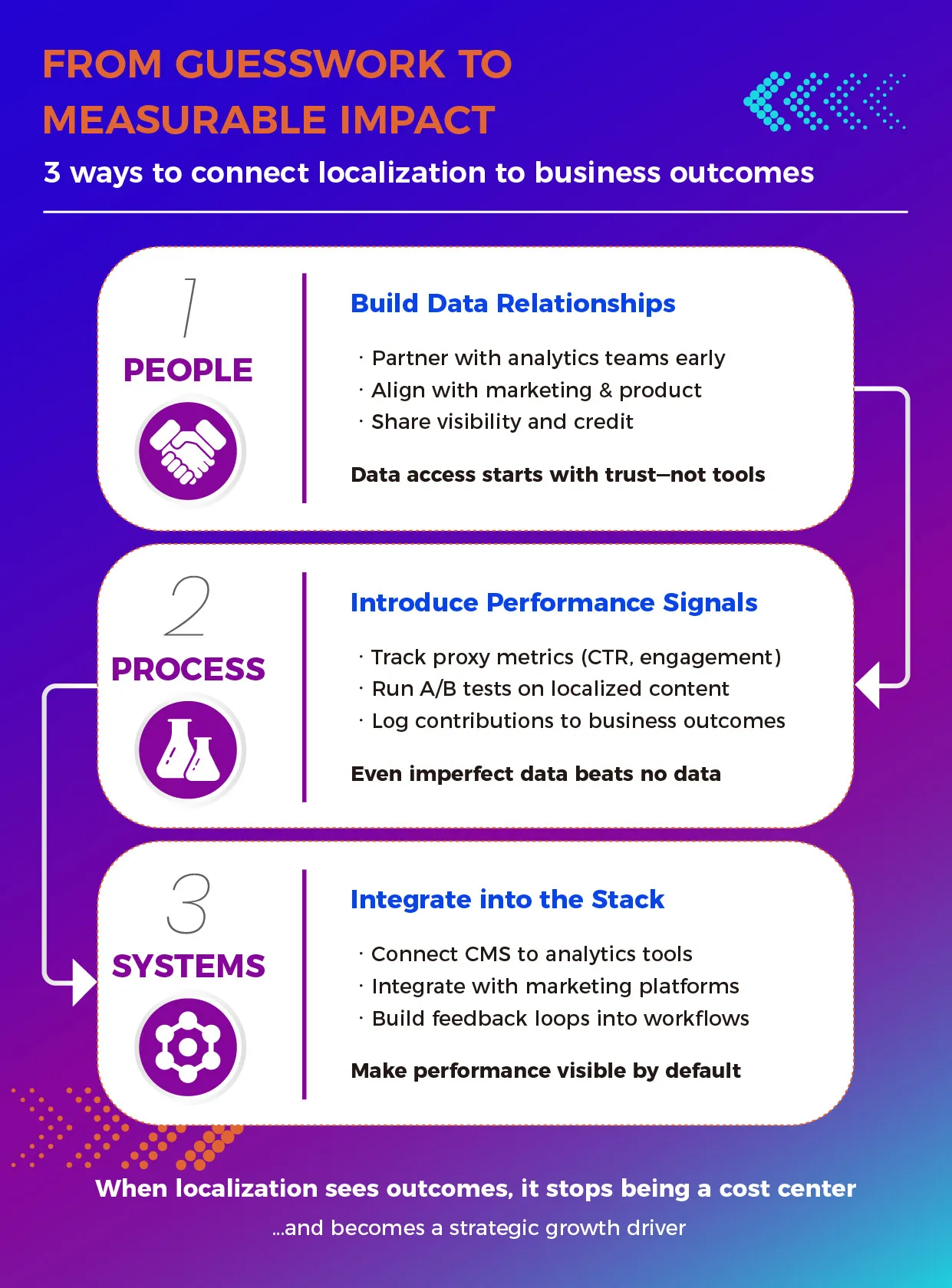
At the most basic level, this means building relationships with analytics and data teams before a business case is needed. Localization leaders who treat data access as a transactional request—something to pursue when they need to justify a budget—will always be playing defense. Those who invest early in cross-functional relationships, offering visibility into localization work and shared credit for wins, will find that data access follows naturally.
At the process level, it means introducing performance signals wherever possible, even when direct attribution is not clean. Proxy metrics—engagement rates, time on page, email click rates, support deflection in local languages—can build a credible performance narrative even without perfect data. A/B testing on localized content, where feasible, turns subjective debates about quality into measurable product outcomes. Contribution logs that track what localization enabled or supported, even without claiming direct causation, create a cumulative record of strategic value.
At the systems level, the opportunity is larger. Integrating localization workflows into the marketing technology stack—connecting a multilingual CMS to a customer data platform, marketing automation tools, and real-time analytics—creates the infrastructure for genuine feedback loops. When localization decisions are made with access to audience segmentation data, and when the performance of localized content is visible in the same dashboards that inform marketing and product decisions, localization stops being a downstream vendor and starts being an upstream strategic contributor.
This is not a trivial transition. It requires advocacy, organizational buy-in, and in many cases, a fundamental reframing of how localization is positioned within the enterprise. But the alternative of continuing to evaluate quality in isolation from the outcomes quality is supposed to create will lead to a slow erosion of localization’s strategic relevance.
From Guesswork to Growth Engine
The operational gap between localization teams and business performance data is not an accident. It is the logical outcome of how localization has historically been positioned: as a support function, a cost center, a production step. That positioning made a certain kind of sense when quality meant linguistic accuracy, because linguistic accuracy could be verified internally.
It makes no sense now.
Quality is behavioral. It is measured by what audiences do after they encounter your localized content—whether they stay, convert, return, or leave. Until localization teams have visibility into those behaviors, they will continue to make important decisions based on incomplete information, and the organizations they serve will continue to leave measurable value on the table.
The good news is that the tools, techniques, and organizational models to close this gap exist. What is required is leadership willing to pursue integration rather than accept isolation.
Ready to measure what matters?
Solving the operational gap starts with data—but seeing results depends on the quality of what you put into market.
Clearly Local helps enterprises deliver high-quality, culturally precise translations built to resonate with real users. That means content engineered to support higher conversion rates, messaging calibrated to drive engagement across markets, and translations rigorous enough to stand up to measurement.
When you’re ready to measure localization fully, make sure you’re working with a partner that gives you something worth measuring. Work with Clearly Local.
FAQS
Localization performance is measured by combining traditional quality checks with outcome-based indicators—such as engagement, conversion, and retention—so that success is defined by both linguistic accuracy and real-world impact.
Localization is often undervalued because it is treated as a downstream production function with limited access to performance data, meaning its contributions to business outcomes remain invisible and uncredited compared to marketing or product teams.
Translation quality affects conversion rates because even accurate content can fail to persuade or resonate with local audiences, whereas high-quality, culturally relevant localization can significantly improve user trust and drive higher conversions.
Localization teams should have access to key performance data such as conversion rates, engagement metrics, retention data, and support ticket volumes by language, which are typically stored in marketing, product analytics, and CRM systems.