

Key Takeaways
- The growth of AI-generated content has plateaued at around 50% because search algorithms and users increasingly resist low-value, undifferentiated AI output.
- Human-written content significantly outperforms AI-only content in top search rankings, highlighting the importance of originality, expertise, and firsthand insight.
- The most effective strategy is a human-led, AI-assisted approach, where AI boosts efficiency while humans ensure quality, differentiation, and trust.
For three years, the narrative was relentless. AI would write the internet. Content teams would shrink. Publishing volume would climb without limit, and the brands that scaled fastest would win the search results, the attention, and the market.
That story has stalled.
According to recent data, the share of primarily AI-generated articles on the web has plateaued at roughly 50% over the last five quarters. After the explosive growth that followed the launch of ChatGPT, the curve has flattened.
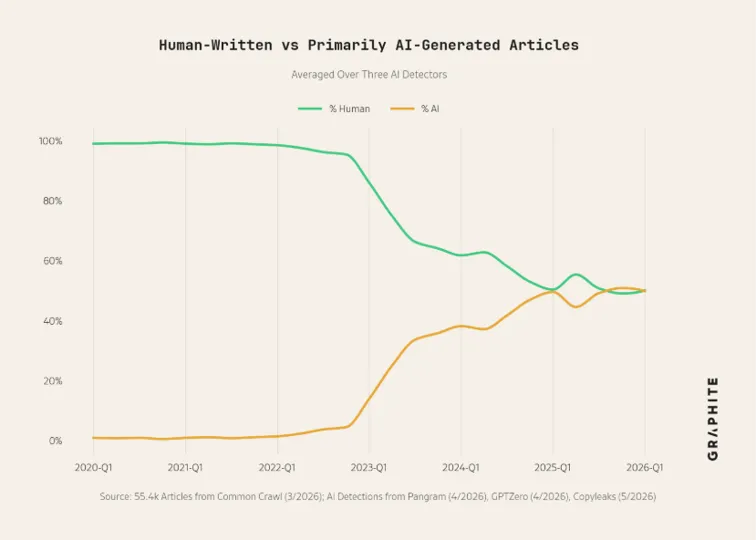
This isn’t a temporary dip. It’s a market correction. The plateau is the visible result of two forces pushing back at the same time: search algorithms that are actively resistant to undifferentiated AI content, and consumers who have grown skeptical of it. Together, they’ve built something that looks a lot like a brick wall.
For global enterprise brands, this changes the strategic question. It’s no longer “Should we use AI to produce content?” Most companies answered that question two years ago, and the answer was yes. The real question now is: how do you use AI without triggering the defense mechanisms that search engines and audiences have built against it?
The Wall: Why “AI-Only” Strategies Fail in Search
The clearest evidence of the wall is in search rankings, and the gap is bigger than most people expect.
AI content now makes up about half of all web content. But human-written pages are roughly 8 times more likely to capture the #1 position on Google. AI content can hold its own further down the page—it shows up reasonably often in positions five through ten. What it struggles to do is win the top spot. Data from SEMrush shows an 80.5% probability that the #1 result is human-written, compared to roughly 10% for AI.
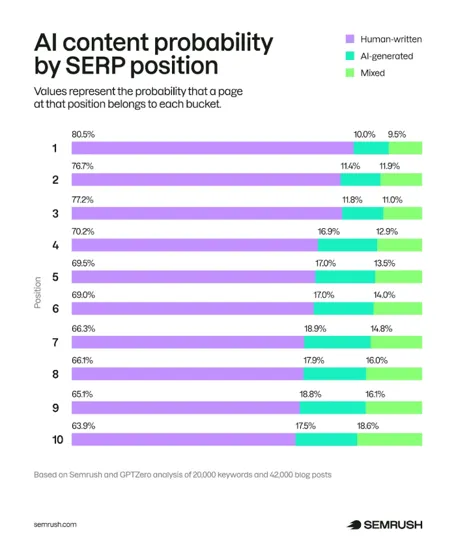
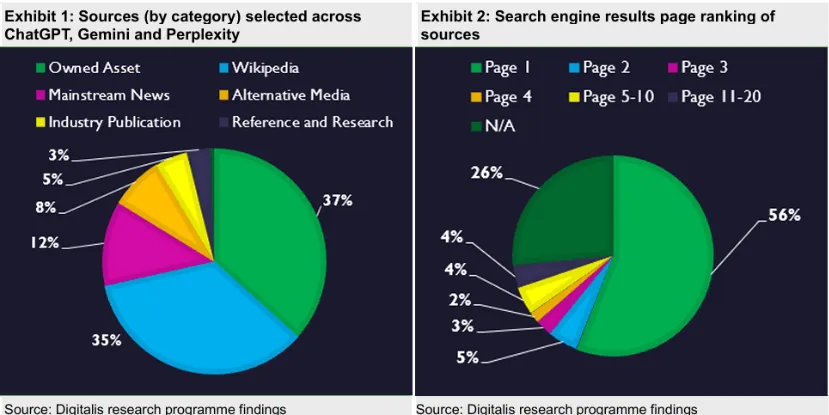
That gap is the difference between a strategy that drives leads and one that drives traffic to page two, where almost nobody goes. And we’re not just talking about people here. Studies have found that over half of all sources cited across major chatbots come from the first page of search results, with some, like Perplexity, showing an even stronger preference at 61%.
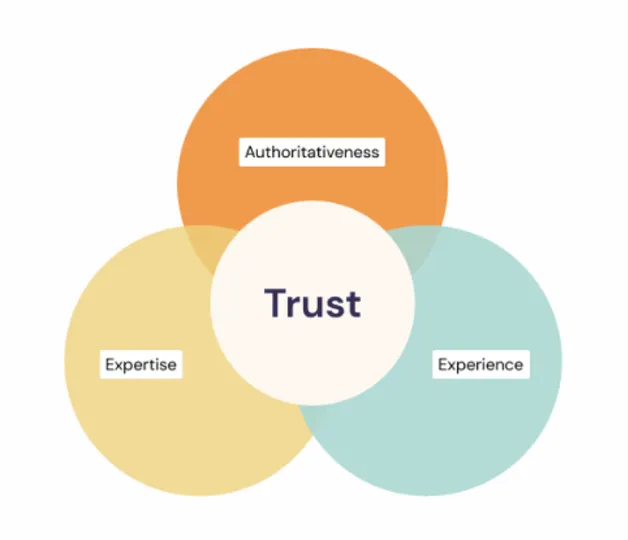
Google has been fairly direct about why this gap exists. The company doesn’t penalize content simply because AI helped write it. But it does reward “original, high-quality content,” and that’s where most AI-only output runs into trouble. A lot of AI-generated content is, structurally, a synthesis of what already exists. It’s competent and fast. But it doesn’t have a point of view, and it doesn’t carry the markers of firsthand experience or specialized expertise that Google’s quality framework—often summarized as E-E-A-T—is designed to detect and reward.
Trust, Brand Integrity, and Market Sentiment
The search ranking problem is the visible part of the wall. The brand trust problem is the part that doesn’t show up in a dashboard, but matters just as much.
According to one study done by CNET in the US, only about 11% of users report finding generative AI content useful. That’s a strikingly low number for content that now makes up half the web. It suggests the algorithmic penalty and the human reaction are pointing at the same underlying problem: a lot of AI content simply isn’t adding much value.
This creates a quiet halo effect around brands that lean on it to heavily. Readers don’t always consciously register “this was written by AI.” But they register the experience—generic, slightly hollow, not quite worth the time—and that experience attaches itself to your brand.
This risk compounds in YMYL (Your Money or Your Life) topics: content that affects your money or your life. Examples include financial guidance, health information, legal explainers, and anything tied to civic or public interest. These are exactly the categories where global enterprises tend to publish the most, and where AI-only content is weakest. YMYL topics require reliability signals, consensus, and demonstrable expertise that purely generative content struggles to produce. For a global brand, getting this wrong isn’t just a ranking problem. It’s a legal and reputational one.
Another more strategic issue that senior leaders are starting to notice is AI content doesn’t differentiate. Speed is not the same as distinctiveness. When every competitor in a category is using similar models to produce similar drafts, the result is a kind of content sameness where brands become indistinguishable from their competitors. In a global market where standing out is the whole point, “vanilla” AI content quietly erodes the thing that’s supposed to set a brand apart.
The Pivot: Human-Led, AI-Assisted
The companies that have figured this out aren’t abandoning AI. They’re changing its job description.
Industry data shows that 87% of SEO teams now ensure humans remain directly involved in the content process, and the most common operating model—used by 64% of teams—is human-led, AI-assisted. Editorial judgment and fact-checking stay firmly in human hands while AI gets a narrower, more useful role: drafting, ideation, summarization, structure.
This is a meaningful shift in how the tool gets used. Instead of asking AI to be the author, leading firms are asking it to be the first-draft machine. They can then reinvest the time that gets saved into the things AI genuinely can’t do, like adding proprietary data, bringing in expert review, or layering in a point of view that comes from actually knowing the subject.
Tooling is starting to reflect this shift, too. Platforms like DescripGen AI are built around the same logic: use AI to handle the heavy lifting of drafting at scale, then route that output through human editorial review before it ever goes live. The tool accelerates the work without replacing the human judgment that makes the work stand out.
Think of it as efficiency plus excellence. AI increases velocity and human expertise supplies the originality that search engines reward and readers respond to. One without the other hits the wall. Together, they get through it.
Turning the Wall Into a Speed Bump
The AI content explosion hit a brick wall because the internet, and the algorithms that organize it, are still fundamentally built around human connection. Search engines were designed to surface expertise and trust. Readers were never looking for content; they were looking for help, insight, or a reason to believe what they were reading. Over-rotating into automation broke that connection, and the data—lower rankings, lower perceived usefulness, eroded trust—shows exactly where it broke.
The future isn’t AI versus human. It’s human plus AI, with the emphasis on what each one is actually good at. The brands that win from here won’t be the ones that published the most. They’ll be the ones that used AI to clear away the friction—the drafting, the structuring, the repetitive groundwork—so their actual experts could spend more time doing the part only they can do.
As search algorithms continue to evolve, that’s likely to remain the durable strategy: not less AI, and not no AI, but AI in service of human expertise rather than in place of it.
Scale Content Without Sacrificing Quality
The data is clear: AI is a tool, not a solution. At Clearly Local, we bridge the gap between global efficiency and local relevance. Our AI-driven content creation services, powered by tools like DescripGen AI, are designed to generate high-volume drafts while retaining the human-led editorial rigor, subject matter expertise, and proprietary insights required to actually rank and convert in international markets.
Don’t just keep up with the volume—lead with quality. Contact Clearly Local to learn how our Human-Led, AI-Assisted model can help you scale globally without hitting the brick wall.
FAQ
AI-generated content growth has slowed because the market has hit a natural plateau driven by two counterforces: search engines increasingly favor original, experience-based content while users have grown skeptical of generic AI output, resulting in about half of all content being AI-generated but no longer increasing.
Google does not penalize content simply for being AI-generated, but it rewards high-quality, original, and helpful material, meaning low-value AI-only content often performs poorly because it fails to meet these standards.
A human-led, AI-assisted content model is one where AI handles tasks like drafting and structuring content, while human experts retain control over editing, fact-checking, and adding unique insights to ensure quality and credibility.
Global brands are adopting hybrid strategies because AI-only approaches lead to undifferentiated, “vanilla” content that harms brand trust and competitiveness, whereas combining AI with human input creates distinct, high-quality content that stands out.
Localization ensures that AI-generated drafts are adapted with cultural relevance, local expertise, and audience-specific nuance, which improves engagement, trust, and effectiveness in international markets.