


Key Takeaways
- Localization testing verifies that translations, layouts, formats, and market-specific functionality are correct for each target market.
- International usability testing reveals how real users behave, where they struggle, and whether the experience meets local expectations.
- Most global launches need both: usability testing to shape the experience and localization testing to validate it before release.
Localization testing and usability testing are often discussed together, but they answer fundamentally different questions. Localization testing checks whether a product is correctly adapted for each market. Usability testing checks whether people in that market can successfully use it. Relying on only one creates risk: a product may be linguistically correct but difficult to use, or easy to use in testing yet contain localization defects that affect customers.
The business impact is significant. CSA Research’s Can’t Read, Won’t Buy study of 8,709 consumers across 29 countries found that 76% prefer to buy products with information in their native language, while 40% will never buy from a website presented in another language. Translation helps users access a product, but it doesn’t guarantee a good experience once they get there.
This article explains what localization testing and international usability testing each reveal, where their limitations lie, and when organizations should use one, the other, or both.
What localization testing reveals that international usability testing cannot
Let’s start with definitions, because these terms are often confused. Internationalization (often “i18n”) is the engineering work that prepares a product for multiple languages, scripts, and regional formats. Localization (“l10n”) is the adaptation itself: translating content and adjusting elements such as dates, numbers, currency, addresses, and other market-specific conventions. Localization testing is the quality assurance process that verifies those adaptations are correct and complete for each target market.
Localization testing uncovers issues that usability testing typically misses because no usability study reviews every string, screen and format in every language. Specifically, it reveals:
- Translation accuracy and completeness. Mistranslations, missing content, inconsistent terminology, and brand messaging that varies across markets.
- Context-specific translation errors. Text that was translated correctly in isolation but becomes incorrect in the interface, such as broken placeholders, incorrect plural forms, or variables appearing in the wrong order.
- Visual and layout problems. Languages such as German, French, and Spanish often take up more space than English, which can lead to truncated buttons, clipped text, and broken layouts.
- Locale formatting issues. Incorrect dates, times, numbers, currencies, or units. For example, 03/04/2026 means March 4 in the United States but April 3 in many other countries.
- Right-to-left language issues. Arabic and Hebrew require mirrored layouts. If navigation elements, arrows, or other directional cues are not adapted correctly, users can be misled.
- Local functionality issues. Problems with address formats, postal codes, phone numbers, regional payment methods, or market-specific legal requirements.
These are concrete issues that can be identified, verified, and fixed before release. This is exactly what platforms like Clearly Local’s easyLT is designed to support: reviewing translations within the actual product interface, comparing source and translated screens side by side, and finding issues such as truncation, overflow, and layout breakage before users encounter them.
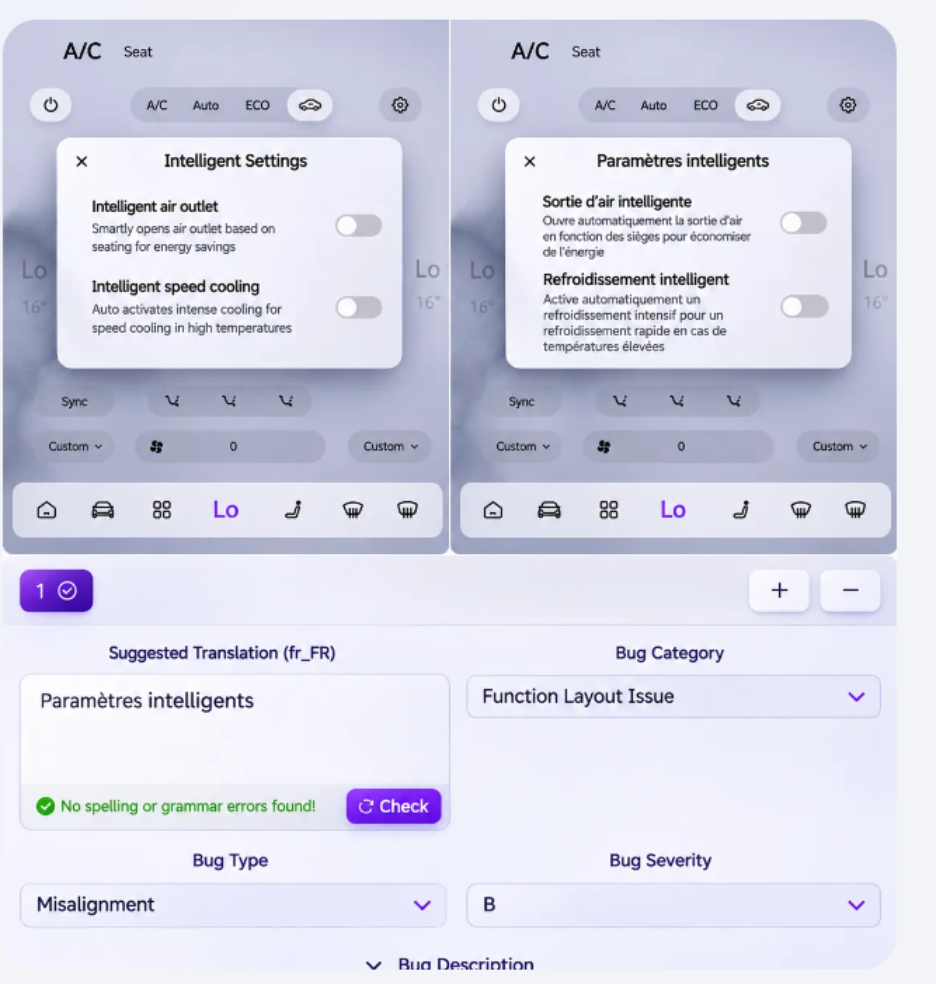
What localization testing cannot tell you is whether people in that market can complete tasks efficiently, understand the experience, or achieve their goals. A product can be fully localized and still be difficult to use. That is where international usability testing provides a different kind of insight.
What international usability testing reveals that localization testing cannot
Usability testing is research rather than Quality assurance. You recruit representative users, ask them to complete realistic tasks, and observe where they succeed, struggle, or abandon the process. According to ISO 9241-11, an international standard for usability, usability is the extent to which intended users can achieve their goals effectively, efficiently, and satisfactorily in a specific context.
While localization testing verifies that a product has been adapted correctly, usability testing reveals how people actually experience it. Specifically, it uncovers:
- Task success and friction. Can users find what they need, complete key actions, and achieve their goals without assistance? In our article last week, we talked about how small usability studies can uncover many of the most significant user experience issues.
- Local expectations and mental models. People in different markets often approach the same task differently. One audience may browse categories, while another prefers search. One may expect detailed product information, while another wants only the essentials.
- Real-world usage patterns. Products are used in different environments and circumstances. For example, Swedish ATMs have very large buttons so they can be pressed while wearing thick gloves in winter, a usability requirement that would never emerge from localization testing alone.
- Trust and market fit. Usability testing shows whether an experience feels natural and trustworthy to local users. Even when translations are accurate, an interface may still feel unfamiliar or out of step with local expectations.
- Missing capabilities and workflows. A checkout flow may be fully translated yet fail because it lacks preferred payment methods, delivery options, sign-in methods, or other features users expect in that market.
The business value of these insights can be substantial. We’ve found that organizations often see significant improvements in key UX metrics after identifying and addressing usability issues through research and redesign.
The key limitation is that usability testing focuses on user behavior, not comprehensive quality validation. It can reveal whether people can successfully use a product, but it cannot systematically verify every translation, date format, layout, or locale-specific requirement across multiple languages and markets. That remains the role of localization testing.
When should organizations use localization testing, usability testing, or both?
The short answer is usually both, but at different stages and for different reasons. Here’s a practical guide.
| Scenario | Localization testing | International usability testing |
| Releasing into a new language or locale | Essential for every release | Recommended for new markets |
| Adding or updating translated content | Essential (regression testing) | Usually not required |
| Entering a new market for the first time | Essential | Essential |
| Engagement or conversion lags in one market | Helpful for identifying localization defects | Essential for finding behavioral causes |
| Redesigning a product for a global rollout | Verify localized builds before launch | Essential throughout design and validation |
A simple way to think about it is:
- Use usability testing early to understand local expectations, behaviors, and workflows before major product decisions are locked in.
- Use localization testing before release to verify that translations, layouts, formats, and market-specific functionality are correct across languages.
- Use both when entering new markets or launching major product changes. A product should be both easy to use and correctly localized.
Organizations sometimes treat these methods as alternatives, but they solve different problems. A successful global launch requires confidence in both.
Conclusion
Successful global launches require more than translation, and they require more than good UX. Organizations need confidence that their products are both correctly adapted for each market and genuinely usable by the people they serve.
That is why localization testing and international usability testing work best together. Usability testing helps teams understand local behaviors, expectations, and workflows before launch. Localization testing helps ensure that the final product reaches users without translation, formatting, layout, or market-specific defects.
For organizations expanding internationally, the goal is not simply to ship a localized product. The goal is to deliver an experience that feels natural, functional, and trustworthy in every market. Using both methods at the right stages of development is one of the most effective ways to achieve that.
Want to Improve Global Product Quality?
Join our upcoming webinar to learn how localization testing helps teams identify translation, layout, and functional issues before release, and see how easyLT streamlines the review process at scale.
If you’re also looking to understand how users in different markets interact with your product, our international usability testing team can help uncover market-specific behaviors and friction points that localization testing alone cannot reveal.
Register for the webinar or contact us to discuss your localization testing and international usability testing needs.
FAQs
Localization testing verifies that a product has been correctly adapted for a specific market, including translations, date and currency formats, layouts, and local functionality. International usability testing evaluates how real users in that market interact with the product and whether they can complete tasks efficiently and successfully.
No. Localization testing can confirm that content and functionality have been adapted correctly, but it cannot reveal whether users understand the experience, encounter friction, or meet their goals. Usability testing is needed to uncover those user experience issues.
Sometimes. Participants may notice confusing translations, culturally inappropriate wording, or localization errors during usability sessions. However, usability testing is not designed to systematically identify all localization defects, so dedicated localization testing is still required.
In most cases, yes. The two methods answer different questions and provide complementary insights. Using both helps organizations ensure that products are technically correct for each market and also easy for local users to use.
It depends on the objective. International usability testing is often conducted early in the design and development process to understand user needs and validate design decisions. Localization testing is typically performed later, after content has been translated and localized, to verify readiness for launch.
Focus on the tasks and interactions that matter most to users and business goals. This may include navigation, onboarding, product discovery, checkout flows, form completion, content comprehension, trust signals, and market-specific expectations that could affect adoption or conversion.
Prioritize markets based on business goals, revenue opportunity, strategic importance, risk level, and planned investment. Within each market, recruit participants who closely match your target users, including relevant demographics, behaviors, language preferences, product experience, and purchasing responsibilities.
Sources
- CSA Research, Can’t Read, Won’t Buy — B2C. https://insights.csa-research.com/reportaction/305013270/Marketing
- Nielsen Norman Group, Usability 101: Introduction to Usability. https://www.nngroup.com/articles/usability-101-introduction-to-usability/
- Nielsen Norman Group, International Usability Testing. https://www.nngroup.com/articles/international-usability-testing/
- Nielsen Norman Group, International Usability Testing: 3 Factors to Consider (2024). https://www.nngroup.com/videos/international-usability-testing/
- ISO 9241-11:2018, Ergonomics of human-system interaction — Part 11: Usability. https://www.iso.org/standard/63500.html
- W3C, Localization vs. Internationalization. https://www.w3.org/International/questions/qa-i18n
- W3C, Internationalization Best Practices for Spec Developers. https://www.w3.org/TR/international-specs/