


When KuCoin integrated ChatGPT into their translation workflows, they expected efficiency gains. What they got instead was inconsistent outputs, decreased translation quality, and poor user experience across multiple language markets. The culprit wasn’t the AI model itself—it was how they were asking it to work.
This scenario plays out daily in enterprises worldwide. As organizations rush to adopt generative AI, they’re discovering an uncomfortable truth: the same AI that produces brilliant results in English can stumble badly in other languages. What’s at stake is brand consistency, customer trust, and operational efficiency across global markets.
Prompt engineering offers a way forward. It’s the practice of designing precise, context-rich instructions that guide AI models toward better outputs. And for global enterprises, it’s becoming one of the most powerful tools available to unlock reliable AI performance across languages, without the cost and complexity of retraining or fine-tuning.
The Multilingual AI Challenge
The fundamental problem is structural. Large language models are trained predominantly on English text, typically 70-80% of their training data. But only 20% of the world speaks English. This creates what researchers callresearchers call an “Anglocentric bias” that shapes how models reason, communicate, and understand the world.
The performance gap is measurable and significant. Research shows that AI systems achieving over 95% accuracy in English comprehension can drop to 70-80% for languages like Arabic and Swahili. One study found that while English-speaking workers improved their business writing using AI assistance, Arabic and Chinese speakers saw smaller gains, and sometimes their outputs became less actionable and creative, particularly for technical tasks.
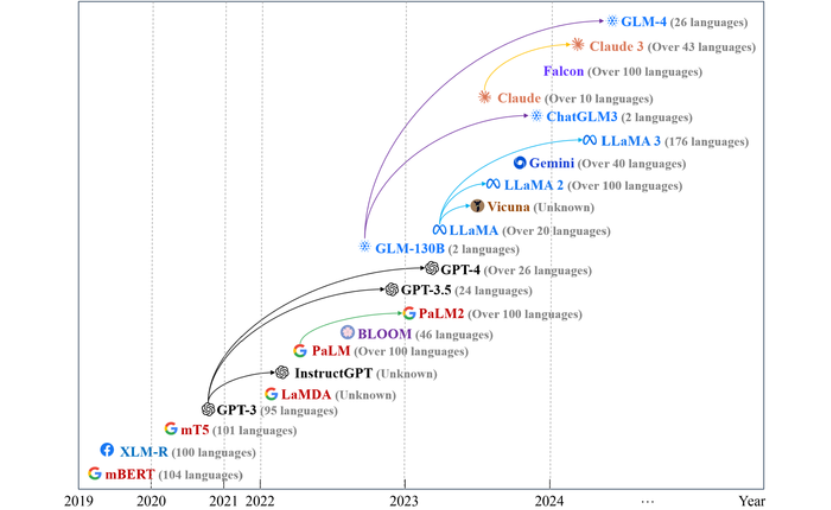
What makes this particularly troubling is the breadth of the divide. For example, Google Translate supports just 133 of the world’s approximately 7,000 languages. ChatGPT and other frontier models support even fewer, and perform well in 8-10 languages before quality drops sharply (90% of all websites are written in just 10 languages).
Even within supported languages, regional dialects and non-standard varieties are systematically marginalized. In one instance, when asked to mimic the narrative voice of an African American character from a novel, ChatGPT merely placed the slang word “yo” at the beginning of random sentences. A similar pattern appears globally:
researchers at UC Berkeley found that ChatGPT’s responses to English dialects from India, Ireland, and Nigeria showed significantly higher levels of condescension compared to responses in American or British English.
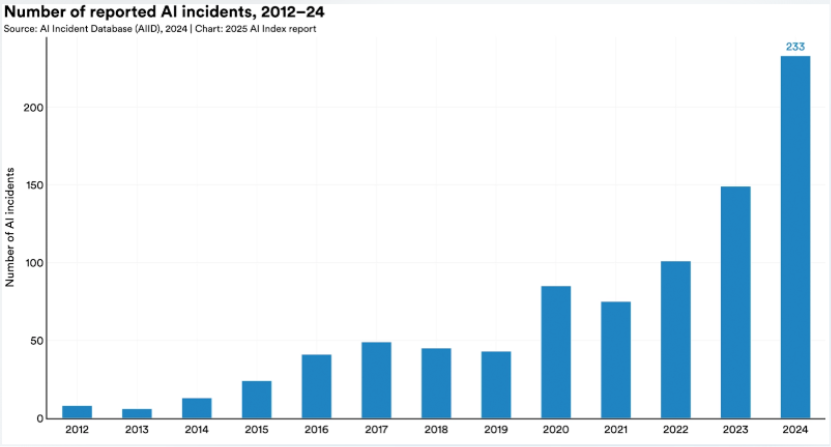
The business consequences are real. Companies risk inconsistent branding, cultural missteps that damage trust, higher localization costs, and increased harmful or biased AI outputs in languages with weaker safety guardrails. For enterprises operating globally, these aren’t edge cases but daily operational challenges that undermine the value proposition of AI adoption.
How Prompt Engineering Solves These Problems
Prompt engineering provides the necessary toolkit to correct these issues. At its core, it’s about helping AI understand intent, context, nuance, and task expectations with precision.
The mechanism is straightforward but powerful. Generative AI models process patterns in language to predict what comes next. A well-designed prompt shapes that prediction by providing clear structure, relevant examples, explicit constraints, and contextual anchors that guide the model’s reasoning process. Think of it as the difference between asking a colleague to “write something about XYZ product” versus providing a detailed brief with audience, tone, key messages, and examples.
For multilingual applications, prompt engineering solves several critical problems simultaneously:
- It reduces hallucinations and factual errors by establishing clear boundaries and verification steps within the prompt itself.
- It guides tone and style to match brand voice and cultural expectations, which is critical when colors, gestures, and formality levels carry different meanings across cultures.
- It improves reasoning consistency by structuring how the model approaches complex tasks, ensuring that logic holds across language boundaries.
Building Effective Multilingual Prompting Systems
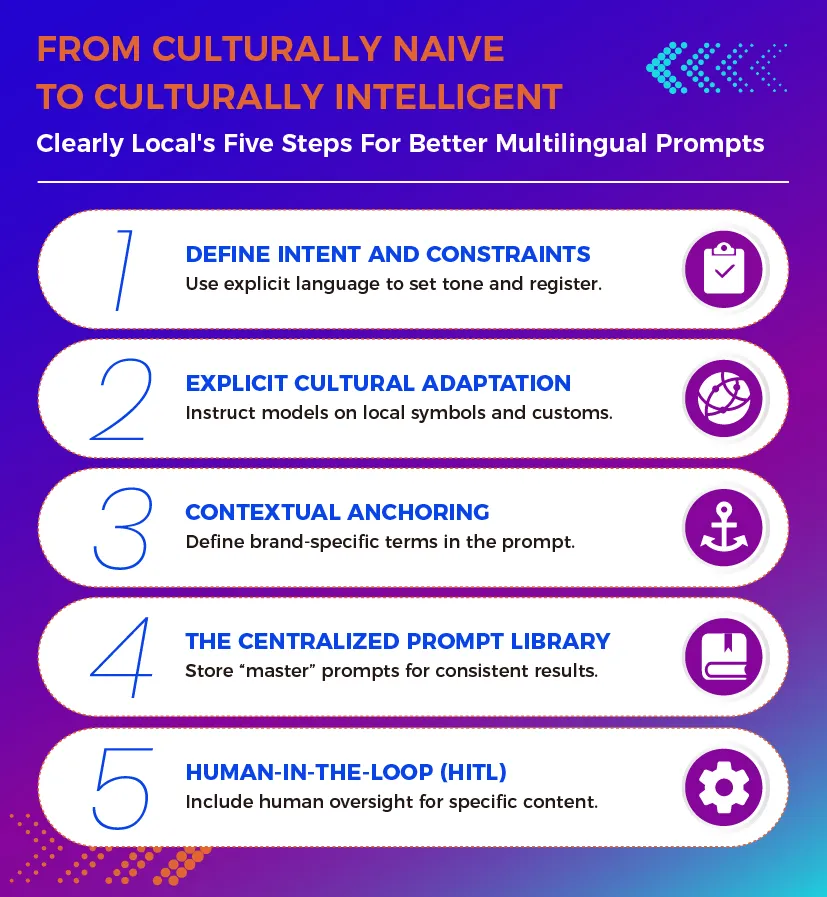
At Clearly Local, we advocate for a structured, five-step framework to move multilingual AI outputs from “culturally naive” to “culturally intelligent”:
- Define intent and constraints:
Use explicit language to set tone and register. Do not allow the model to default to its “standard” phrasing. - Explicit cultural adaptation:
Models must be told how to navigate local symbols. For example, explicitly instruct the AI that white symbolizes funerals in India but purity in Western contexts, or that the thumbs-up gesture is offensive in parts of the Middle East. - Contextual anchoring:
Define key terminology within the prompt. This prevents ”semantic drift,” where the meaning of a brand-specific term slowly changes as it is translated across multiple languages. - The centralized prompt library:
Maintain a repository of “master” prompts that have been proven to generate consistent results. This ensures that marketing, support, and R&D teams are all speaking the same global brand voice. - Human-in-the-loop (HITL):
The best prompts don’t eliminate the need for human oversight in legal, medical, or financial content. Prompt engineering reduces the editing burden, but final sign-off by domain experts remains essential.
Case Study Highlight: Clearly Local and KuCoin
Our partnership with the global cryptocurrency exchange KuCoin highlights the transformative power of this five-step approach. KuCoin struggled with inconsistent AI translations in Turkish, Vietnamese, and Brazilian Portuguese, critical markets for the crypto sector.
The breakthrough came when we diagnosed that KuCoin’s initial prompts were too verbose. They contained long, overfitted glossary explanations that diluted the model’s focus. But verbosity wasn’t the only issue. Native linguists identified and corrected patterns that reflected deeper structural weaknesses, like inconsistent terminology and other variations across languages that aligned with the known performance gaps and biases multilingual models often exhibit.
These changes led to significant improvements:
- A 20% boost in overall translation quality.
- A 2/3 reduction in prompt length, lowering costs and increasing speed.
- Near-human-level quality that allowed the AI to handle complex blockchain terminology with high reliability.
The key takeaway from this project is that prompt engineering can turn underperforming AI into genuinely useful business tools, without relying on new model releases or costly fine-tuning.
Importantly, prompt engineering works within existing systems. Organizations don’t need to retrain models, rebuild infrastructure, or abandon their AI investments. They need to ask better questions and provide better context. For global enterprises already struggling with AI’s language gaps, this is a practical path forward.
Conclusion
Prompt engineering is one of the most effective tools available today for closing the AI language gap that enterprises face right now. While the structural challenges of English-dominant training data won’t disappear overnight, organizations can immediately improve their AI outputs across languages through better prompt design.
For global enterprises, this represents one of the highest-leverage interventions available. As AI becomes embedded in everything from customer support to content creation to decision support systems, the quality of your prompts directly shapes the quality of your business outputs across markets. Organizations that master multilingual prompt engineering will unlock AI’s value for non-English-speaking teams and customers.
Are you equipped to ensure AI quality across all the languages your business depends on? If you’re ready to explore how multilingual prompt engineering can transform your AI outputs, Clearly Local’s team of linguistic experts and AI specialists can help you build prompts that work as well in your target languages as they do in English.
Request a consultation to discover what’s possible. Clearly Local is hosting a live webinar and it’s all about what actually determines whether AI performs in the real world. Sign up