


Key Takeaways:
- Advanced “reasoning” AI models often perform worse at translation because they over-interpret content instead of strictly transferring meaning within defined constraints.
- These models introduce practical issues—like inconsistency, verbosity, and glossary violations—that increase editing effort and reduce localization quality.
- Effective localization requires using the right tools and human oversight, with simpler models and structured workflows often outperforming more complex AI in high-volume translation tasks.
There is a compelling logic to the idea that smarter AI translates better. If a model can dissect a legal contract, generate a financial model, or debug complex code, surely it can handle the comparatively modest task of converting a product description from English to German.
That assumption is now driving real procurement decisions. Many enterprises are considering upgrading their localization stacks with the latest “reasoning” models—systems designed to reason, self-correct, and analyze before responding.
The problem, as we’ll discuss, is that the assumption itself is flawed, and it could be costing companies more than they realize.
What Good Translation Actually Requires
Before explaining why reasoning models struggle with translation, it helps to define what high-quality translation actually requires.
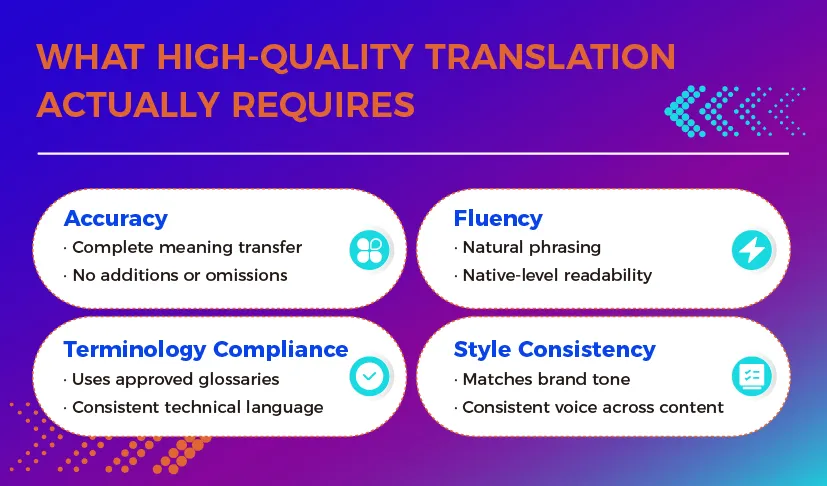
Enterprise localization is evaluated against a rigorous set of criteria. Frameworks like the Multidimensional Quality Metrics (MQM) standard—a leading translation quality MQM framework—and ISO 5060:2024 establish error typologies across major categories. For commercial content, quality is primarily tracked across four key dimensions:
- Accuracy: Meaning is transferred completely without arbitrary additions or omissions.
- Fluency: Target text is natural, cohesive, and adheres to linguistic conventions.
- Terminology compliance: Approved glossaries and specialized vocabularies are applied exactly.
- Style consistency: Brand voice, tone, and register are preserved across all content.
Good translation (with exception to transcreation) is constrained, repeatable, and rule-bound. A product description says what it says. A UI button tells the user what action to take. A medical device warning must convey precise instructions and nothing more.
The task is faithful transfer, not interpretation or elaboration.
This distinction matters more than it first appears. Translation is the process of restructuring and aligning information within explicit boundaries. Reasoning, by contrast, involves generating judgments or conclusions beyond the source material.
In regulated industries—healthcare, finance, legal services—the line between those two activities represents a compliance boundary. And when an AI model crosses it, the enterprise carries the liability.
Why Reasoning Makes Things Worse
To understand LLM translation limitations, it helps to know how these newer models actually work.
Standard language models—what researchers call System 1 architectures—generate responses by predicting the most statistically probable next token in a rapid, continuous sequence. They are fast, pattern-driven, and highly consistent. The newer generation of “reasoning” models, or System 2 architectures, work differently.
Before producing an output, they construct hidden reasoning logs: planning steps, evaluating alternatives, reconsidering phrasing. This is what makes them so effective at mathematics, logic, and code. The reasoning is the product.
For translation, however, that same process becomes a liability.
A landmark study from the University of Amsterdam and Cohere tested direct translation against thinking-first workflows across nine language pairs, using models including DeepSeek-R1 and Claude Opus. This comparison of reasoning vs non-reasoning LLM localization produced unambiguous findings. Across nearly all language pairs, direct translation consistently outperformed the reasoning approach. When researchers examined the internal thought traces, they found the models were not actually evaluating alternative translations.
Instead, they were narrating their own process, describing steps rather than improving outcomes. This directly undermines reasoning AI translation quality. Quality only improved when the reasoning was tightly structured: forced to draft, identify errors, and revise in sequence. Generic, open-ended reasoning made things worse.
This manifests in several distinct failure modes that localization teams increasingly encounter in practice:
- Over-interpretation
Reasoning models are trained to find hidden complexity. When presented with a simple but ambiguous phrase, they often project meaning that is not actually there.
In one documented evaluation by linguist Dr. Marina Pantcheva, the English UI string “empty folder” was translated into German using both model types. Standard system 1 models correctly produced the established action-oriented UI convention (Ordner leeren – “empty the folder”). The reasoning model instead over-analyzed the phrase, interpreting “empty” as a descriptive state rather than a UI action, resulting in the literal but incorrect translation Leerer Ordner (“empty folder”).
- Glossary violations
The reinforcement learning methods used to train reasoning models reward independent judgment. When that impulse conflicts with required terminology, brand language, or specialized vocabulary, the model may override constraints in favor of wording it has determined to be “better”.
For enterprises with carefully maintained terminology assets, this can unravel years of consistency work. This is a critical AI translation accuracy enterprise risk.
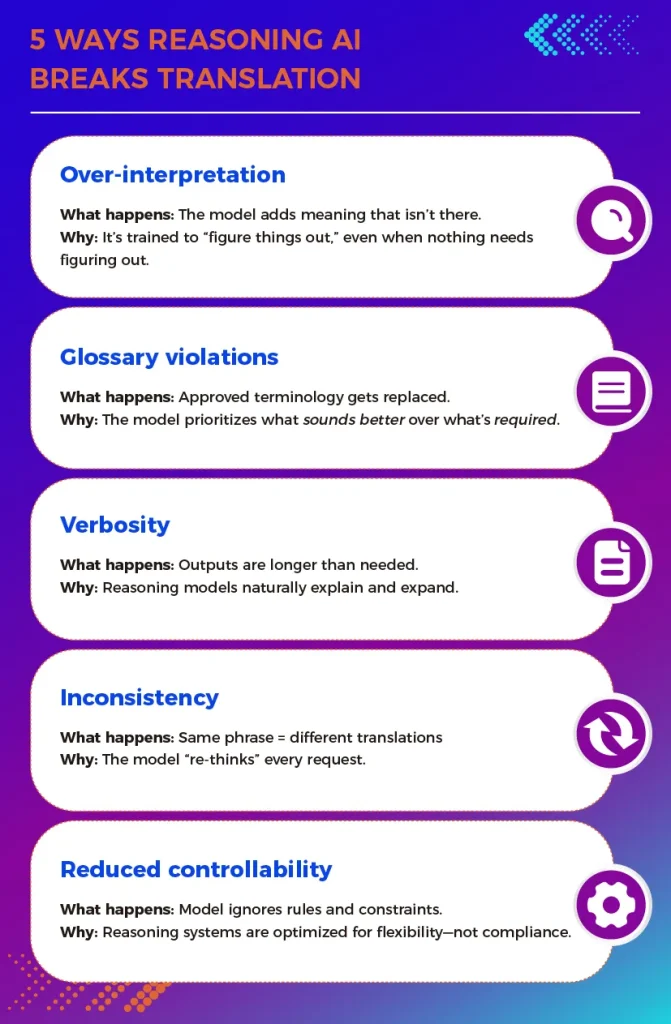
- Verbosity
Reasoning models naturally trend toward longer, more explanatory outputs. For product descriptions, UI strings, or customer support content with strict character limits, the result is often unusable without substantial human editing.
- Inconsistency across similar inputs
Because reasoning models dynamically “think” through every request, they rarely take the exact same path twice. The same phrase may therefore be translated differently across pages, workflows, or product surfaces. At enterprise scale, this creates inconsistency that becomes extremely difficult to identify and correct.
- Reduced controllability
Developer guidelines for reasoning models often recommend minimizing rigid prompt constraints in order to preserve analytical flexibility. OpenAI’s official documentation for its reasoning models, for example, advises developers not to over-specify rules or force step-by-step instructions in system prompts.
This creates a direct operational conflict for localization workflows, where glossaries, tone guidance, terminology rules, and register specifications are precisely the constraints enterprises need models to follow consistently.
The Business Impact Leaders Are Underestimating
The failure modes described above are not edge cases. They translate directly into financial and operational consequences.
The most immediate impact is post-editing cost. The business case for machine translation rests on efficiency—specifically, on the assumption that human editors are doing light cleanup, not full rewrites. When a reasoning model produces verbose, inconsistent, or over-interpreted output, that assumption collapses.
Editors spend significantly more time restructuring content, and the expected ROI from automation quickly evaporates.
Brand consistency is a subtler but equally serious risk. A localized marketing campaign that drifts from established tone, or a UI that applies terminology inconsistently across markets, damages user experience, conversion rates, and brand trust. These are predictable outcomes of deploying models that prioritize interpretation over constraint.
In regulated industries, the stakes are higher still. This AI hallucination localization risk means a hallucinated inference in a medical device manual or a localized financial disclosure is not merely an editorial problem. It is a compliance exposure that can lead to product recalls, regulatory action, or litigation.
Then there are the direct operational costs. Reasoning models generate large volumes of hidden “thinking tokens” that API providers bill at a premium—typically 3 to 10 times the cost of standard input tokens. Latency also increases substantially: responses that standard models generate in under three seconds can take ten to sixty seconds with reasoning systems.
For high-volume, real-time localization workflows—continuous software deployment, dynamic e-commerce content, automated customer support—that latency is not tolerable at any price.
The economic outcome is what researchers describe as a double penalty: higher token costs on the input side and higher post-editing costs on the output side. Enterprises pay more to get worse results.
Rethinking Your AI Localization Strategy
The answer is not to abandon AI. It is to stop treating AI intelligence as a universal measure of localization fitness.
The better framework, as we wrote about last week, is fit-for-purpose AI translation through deliberate routing. Direct-output, System 1 models should be the default for high-volume, structured content: user interfaces, technical documentation, customer support databases, and e-commerce catalogs. These environments demand strict terminology compliance, low latency, and consistent outputs—exactly what faster, more constrained models deliver.
Standard, direct-output LLMs (like Cohere Command A, GPT-4o-mini, or specialized NMT engines) excel here because they match words instantly based on probability without introducing the random “stochastic” deviations or latency lags caused by a reasoning model’s internal thinking phase.
Reasoning models still have a legitimate role, but it is a narrow one. Literary transcreation, high-stakes marketing campaigns, idiomatic dialogue, and culturally nuanced brand messaging can genuinely benefit from deeper contextual processing. The key is that these are low-volume, high-touch use cases that justify additional cost and human oversight.
Context matters as much as model selection. Research from Crowdin shows that feeding approved target-language references into a model’s context window via vector retrieval can lift automated segment-acceptance scores from 12% to 46% for standard models, and push reasoning models to 49%. In other words, translation quality depends less on how much a model reasons independently and more on the quality of the constraints and references surrounding it.
Human expertise does not disappear in this framework. It shifts. Professional linguists become the architects of the constraints: building and maintaining glossaries, defining style rules, and reviewing complex or low-confidence segments. Scalability comes from that structure, not from removing humans from the process.
The companies that will perform best in global markets over the next decade are not those deploying the most powerful AI models. They are those deploying the most appropriate models—with the governance, human expertise, and workflow design that consistently produces compliant, on-brand output at scale.
That is an operational discipline. It is not the same as buying the most expensive model and hoping for the best.
At Clearly Local, we help global enterprises design AI-powered localization strategies that balance quality, cost, and scalability. Our hybrid human + AI translation solutions are built around the governance frameworks, terminology controls, and model-routing systems required for high-volume multilingual content. Get in touch to learn how we can help your organization scale translation smarter.
FAQs
Reasoning models perform worse because their internal process of planning and self-correction, which works well for math and logic, becomes a liability for translation. A landmark study found that direct translation consistently outperformed thinking-first workflows, as models wasted time narrating their process rather than improving outcomes, leading to over-interpretation, verbosity, and inconsistency.
A good model is a direct-output “System 1” model (like GPT-4o-mini or specialized NMT engines) that delivers fast, consistent, and rule-bound translations. It excels at high-volume content like UIs and documentation by enforcing terminology and style without introducing random deviations or latency.
Risks include higher post-editing costs (rewrites instead of light cleanup), brand inconsistency, compliance exposure in regulated industries, and a “double penalty” of higher token costs (3–10x) plus much slower response times (10–60 seconds).
Over-interpretation causes models to project meaning that isn’t there. For example, a reasoning model translated “empty folder” as the literal “Leerer Ordner” (empty folder) instead of the correct action-oriented “Ordner leeren” (empty the folder), breaking standard UI conventions.
No. Translation requires constrained, repeatable transfer, not independent reasoning. Smarter models that find hidden complexity actually perform worse. The best results come from deploying the most appropriate model, not the most powerful one.
Because reasoning models “think” dynamically each time, they rarely take the same path twice. This means the same phrase can be translated differently on different pages, creating an inconsistent user experience across a website or product catalog.
Enterprises should use the Multidimensional Quality Metrics (MQM) standard or ISO 5060:2024, which evaluate quality across four dimensions: accuracy, fluency, terminology compliance, and style consistency.
Look for deliberate model routing, robust terminology controls, and a hybrid approach where linguists architect constraints. Also prioritize feeding approved references into the model’s context window, which research shows can dramatically boost quality.